
The world of self-indulgent blogging has been without me since I bored anyone brave enough to read 2000+ words of my writing silly, recounting my run at the Belfast City Marathon on 5th May. A lot has happened since then, except for running. No injuries – thankfully – but no impressive results either. I was warned: after a marathon you might feel flat, underwhelmed and unmotivated. Of course, I didn’t believe that would ring true for me, and, of course, I was wrong. The first mistake I made was trying to come back too quickly. I had booked flights to Belfast for the weekend of 8th/9th June, hoping to run the Northern Irish 5000m Championships on the Saturday and then hit the town that night to celebrate my 23rd birthday. Soon after recommencing training I picked up a knee niggle, though, and given I only had 5 weeks between the marathon and the championships, that minor injury derailed any chance of making an appearance. I still went to Belfast, running the Ormeau parkrun in 17:33 with a sore head, and enjoyed a busy birthday which eventually ended with a hungover trudge to the bus down to Dublin in the early hours of Sunday 9th June.
At the end of June I completed my contract in Segovia and en route back to the UK decided to jump into a 10km road race in Madrid – 35:35 for 6th, again with a sore head after a farewell night out/tinder date in Segovia. Not great, then straight to the airport to get back to Blighty. A few days of house hopping, visiting friends in the South West and racing another 10km – 35:51 for 3rd, sin hangover (this time on a tough multi-terrain course in Reigate, near Guildford) . Then four weeks of work at a summer camp near Reading, doing very little running and spending a lot more time than anticipated in the Fox & Hounds pub. Those four weeks came to an end, and I was straight off to a party in the south west, followed by an engagement party in Belfast and then back to England just in time for a night out in London before boarding a flight to visit Portland, Oregon for ten days. Despite being a distance running mecca, Portland is not a great place for training if you lack self-control – I hate to imagine how many dollars were spent in the bars, eateries and dispensaries of that strange, strange city. “Keep Portland Weird” is apt.
There was of course some running. The highlight had to be getting terribly, terrifyingly lost in “Forest Park”, running 26 instead of the intended 12 kilometres on steep forest trails. Knowing that bears and mountain lions inhabit that forest made for a long and stressful 2 hours! After ten frankly hilarious days, it was time to make the long old trek back to England, via Iceland (where I completely failed to address my jet lag problem by going to bed at midday, waking up at 7pm, going for a run around the airport area and then spending a few hours in the hostel bar). The flight from Portland to Keflavik was a hefty 8 hours, though the time passed more quickly than usual with my head buried in Phil Knight’s “Shoe Dog”, the story of the creation of Nike and a gift from a generous Oregonian. Keflavik to Gatwick was a far shorter, 3-hour trip, and on arrival in London I was a bit disappointed to have my big holiday of the year behind me but happy to not be travelling anymore after a 31-hour transit from Portland to London.
A quick spin around the London parks with Runner Beans Podcast host Gerard Heaney, another night out in London, and I finally stumbled back into my great aunt’s house to catch up on so much lost sleep the following day. I had a few days to get my life in order, and then the summer was over – time to get back to work. This time in sunny Almería, Andalucia. The intention was to get stuck into marathon training on arrival, but with a tricky first fortnight trying to find a flat, and the ease with which I discovered the tapas bars and nightclubs of the city, the start date for marathon training was pushed back. Finally, in mid September, it began. Marathon training cycle número dos: target – Maratón Málaga; date – Sunday 15th December.
The Training
There’s a reason this blog has been quiet for so long. What you are about to read is not impressive. It is not the textbook, consistent log of the marathon runner I would like to be. It is what it is. Read on (if you wish):
Week 1: 9th – 15th September
103km. No sessions. One steady run (55 mins @ 4:09/km). One “long run” (23.1km @ 4:33/km). A start.
Week 2: 16th – 22nd September
108km. Two sessions: Tu – 15×1’/1′ fartlek (3:25/km av. for minutes); F – 45′ progression (15′ @ 4:51/km, 15′ @ 3:55/km, 15′ @ 3:35/km). One long run (28.2km @ 4:31/km).
Week 3: 23rd – 29th September
122km. Two sessions: Tu – 12×2’/90″ fartlek (3:26/km av. for the 2′ reps); F – 2×20′ tempo, 4′ recovery jog (3:37, 3:38/km av.). One long run (28.4km @ 4:29/km).
Week 4: 30th September – 6th October
123km. Two sessions: Tu – 8×4’/2′ fartlek (3:33/km av. for the reps); F – 3x3K/1K float (3:29/km for the 3K reps, 4:18 & 4:20 for the float recoveries). One long run (35km @ 4:28/km). Second half of the week performed in an ever-present hungover fog. 3km reps performed on pure self-loathing.
Week 5: 7th – 13th October
14km. Two runs either side of a five-day lay-off due to sickness. That’s why you shouldn’t spend the whole weekend running around drunk in a T-shirt. Even in warm climes such as these.
Week 6: 14th – 20th October
135km. One session: Th – 12x800m/200m jog recovery (av. 2:41 for the reps, starting at 2:50 and working down to 2:32 for the last). Two long runs: a 22km mountain run on Tuesday and a 31.2km effort on Sunday – 90′ steady + 12×1’/1′ fartlek (3:16/km av. for the minutes, 4:15/km av. for the whole run). That’s more like it. Biggest running week ever.
Week 7: 21st – 27th October
138km. Two sessions: Tu – 4×1200-1200/200j, 400j between sets (av. 4:07 for the reps); F – 3x5K/1K float (17:47, 4:15, 17:17, 4:14, 17:29 = 17km @ 3:35/km). One long run – 2h 30′ @ 4:05/km (36.7km). Great week, especially Friday and Sunday’s efforts. Biggest ever running week (second week in a row).
Week 8: 28th October – 3rd November
44km. What goes up must come down. After two incredible weeks I chanced my arm on Sunday’s run, pushing the pace in the second half and coming away with two enormous blisters, one on each foot! That kept me out of action until Thursday, by which point I was an apathetic mess and completely “psyched out”. A couple of easy runs but nothing special. Had a good chat with the boss (my coach, Sonia) in the evening which propped me up a bit.
So that’s that. This week has been better than last, but I’ll save the details for another blog, because there is more interesting news in the running world than my distinctly-average training…
2019 – the year the marathon went crazy
4% shoes. Next% shoes. The INEOS 1:59:59 challenge. Brigid Kosgei’s 2:14:04 world record. Geoffrey Kamworor’s 58:01 half marathon world record. Eliud Kipchoge doing Eliud Kipchoge things. Kenenisa Bekele running 2:01:41 in Berlin in September. The list goes on.
After Eliud Kipchoge ran 2:01:39 in Berlin last September, it seemed the ceiling of marathon running had been reached. That assumption has been proven to be wildly off the mark. The year began with Getaneh Molla running the fastest-ever debut at the 42.195km distance with a 2:03:34 clocking at the Dubai Marathon. One the women’s side, in the same race, Ruth Chepngetich ran 2:17:08 to launch herself to number 3 on the women’s all-time marathon list, behind only Paula Radcliffe (2:15:25) and Mary Keitany (2:17:01) at the time.
In April, the London Marathon took place, which provided the stage for a masterful marathon performance from the man who beggars belief every time he toes a start line: Eliud Kipchoge. 2:02:37 for what appeared to be an easy win. More on him later. What was more striking was the fact he had company deep into the second half of the race – up to the 116th minute, as Mosinet Geremew clocked 2:02:55 to finish second and Mule Wasihun clocked 2:03:14 in 3rd. What a world we live in, where it is possible to run 2:02 and finish 2nd. And 2:03 / 3rd! On the women’s side, Brigid Kosgei demolished a high-class field to clock 2:18:20 – with a rapid 66-minute second half marathon.
September brought the return of the man who is, in my opinion, the greatest distance runner of all-time. Kenenisa Bekele, after years of injuries, returned to the winners’ circle with an astounding 2:01:41 run at the Berlin Marathon, just two seconds shy of Eliud Kipchoge’s 2:01:39 figures. Just as in London, 2nd place ran 2:02(:48 – Birhanu Legese), and 3rd 2:03(:36 – Sisay Lemma – completing an all-Ethiopian podium).
And then, just when the year seemed to have peaked in terms of marathon-craziness, the “impossible” happened. Two years on from the heroic but ultimately failed attempt on the 2-hour barrier in the marathon at the Monza race track in Italy, Eliud Kipchoge stormed to a mind-bogglingly-quick 1:59:40 performance in Vienna, Austria. Accompanied by teams of world-class pacers from the start to a few hundred metres from the line, Kipchoge effortlessly reeled off 2:49/2:50 kilometres before making a final charge at the line in the closing kilometre.
If I am to speak my mind, though, I preferred the Monza event in May 2017. At that time, the marathon world record stood at 2:02:57 to Dennis Kimetto of Kenya, and sub-2 seemed an outrageous prospect. The buildup was intense, and watching Kipchoge find his limits, as the seconds heart-breakingly ticked over 2:00:00 with more than 100 metres remaining in the race was the kind of sports drama that earns lifelong fans. INEOS’ manta of “No Human is Limited” certainly applied to Kipchoge – the INEOS event seemed like a done deal from the outset, with only 25 seconds to cleave off and a much more sophisticated set-up than in Monza. Despite that, it was a moment that was hard to not enjoy. The buzz of the final kilometres as fans lined the course and the dream-team of pacers escorted Kipchoge around the course was electric – I could feel that even through the screen of my laptop! And those “he’s really, actually, done it” moments are rare. Best to enjoy.
Then, just days later, Brigid Kosgei flipped the script on the world of women’s marathon running by taking apart Paula Radcliffe’s “unbreakable” 2:15:25 then-world-record, running 2:14:04 to take the Chicago Marathon by storm, minutes ahead of her nearest competitor.
And it would be amiss to fail to mention the marathon success of masters athletes this year. Locally in lil’ old Norn Iron, Tommy Hughes (with a lifetime best of 2:13:59 and Olympic representation in the marathon in years gone by) has run three stellar marathons this year – 2:30 in April, 2:32 in June and most recently 2:27:52 in October at the Frankfurt Marathon, all at the age of 59! Sinead Diver, a 42-year-old mum from Australia (via Ireland) has put together an incredible season as well, with a 2:24:11 PB in London in the spring and an equally impressive 2:25 on the testing New York course just a few days ago.
And what links all of these performances together, apart from being outstanding? Well, every time or placing mentioned above was performed in a pair of Nike racing shoes, either Nike 4%, Next% or in Kipchoge’s case, an unreleased prototype. It is worth noting that as the biggest fish in the running pond, Nike already has the allegiance of the best athletes in the game, so to give them all the credit for these performances would be to overlook the dedication, hard work and whatever else these athletes are putting into their performances. But as both the amateur and professional ranks wear an increasingly less diverse range of footwear, and sponsored athletes from other companies have begun wearing blacked-out versions of their shoes, it seems that Nike has a stranglehold on the market and produced a shoe which provides a clear advantage. The debate has already been overdone, every running blog, podcast or training run conversation has featured something about the shoes. If I were a member of Nike’s marketing team, I’d be elated. They have won the war, and changed marathon running forever. Now if someone could lend me £250, I might be able to run a quick marathon next month.


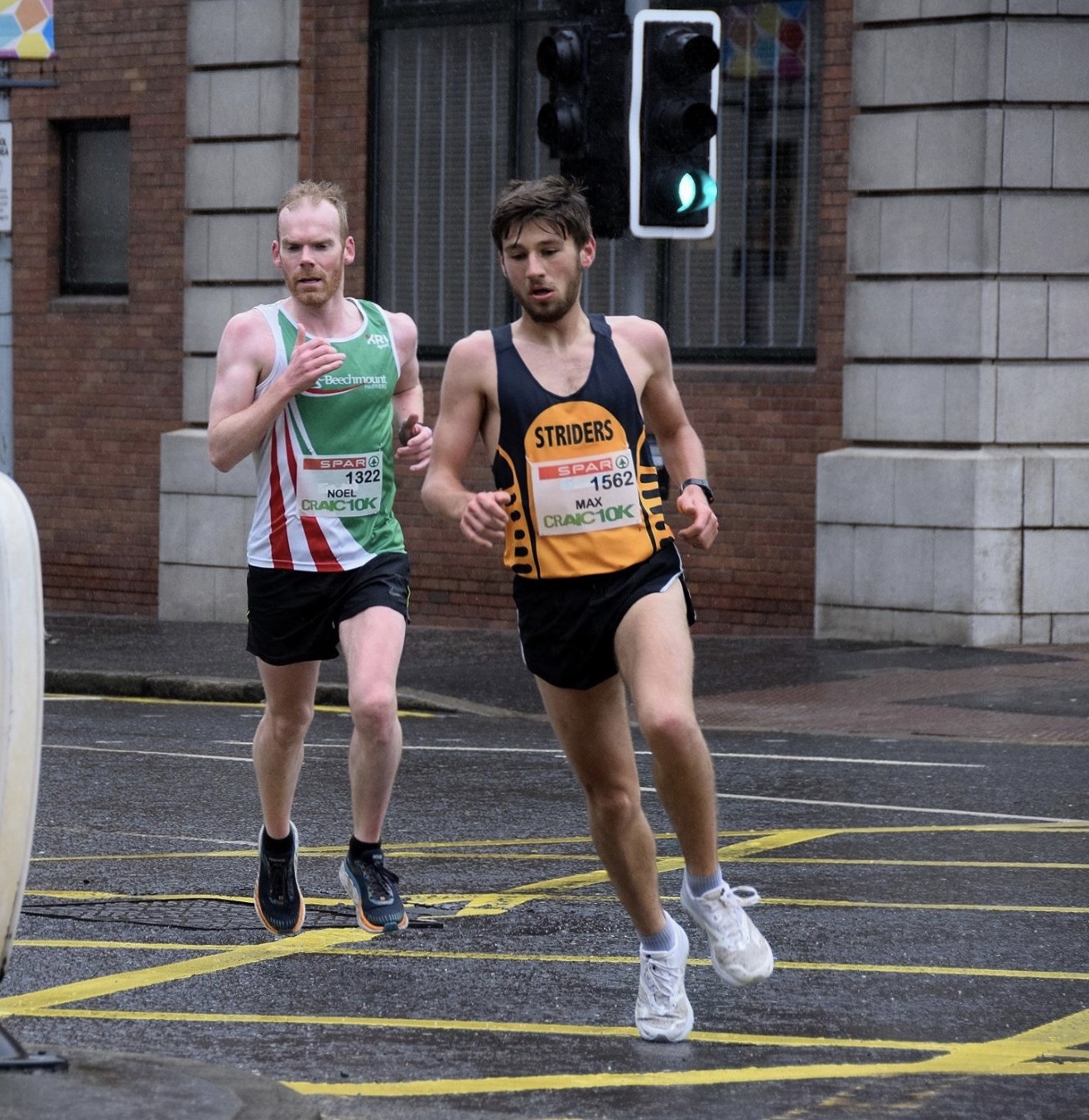


 Max runs a marathon