Guess who’s back, guess who’s back, guess who’s back, guess who’s back, guess who’s back?

The world of self-indulgent blogging has been without me since I bored anyone brave enough to read 2000+ words of my writing silly, recounting my run at the Belfast City Marathon on 5th May. A lot has happened since then, except for running. No injuries – thankfully – but no impressive results either. I was warned: after a marathon you might feel flat, underwhelmed and unmotivated. Of course, I didn’t believe that would ring true for me, and, of course, I was wrong. The first mistake I made was trying to come back too quickly. I had booked flights to Belfast for the weekend of 8th/9th June, hoping to run the Northern Irish 5000m Championships on the Saturday and then hit the town that night to celebrate my 23rd birthday. Soon after recommencing training I picked up a knee niggle, though, and given I only had 5 weeks between the marathon and the championships, that minor injury derailed any chance of making an appearance. I still went to Belfast, running the Ormeau parkrun in 17:33 with a sore head, and enjoyed a busy birthday which eventually ended with a hungover trudge to the bus down to Dublin in the early hours of Sunday 9th June.

At the end of June I completed my contract in Segovia and en route back to the UK decided to jump into a 10km road race in Madrid – 35:35 for 6th, again with a sore head after a farewell night out/tinder date in Segovia. Not great, then straight to the airport to get back to Blighty. A few days of house hopping, visiting friends in the South West and racing another 10km – 35:51 for 3rd, sin hangover (this time on a tough multi-terrain course in Reigate, near Guildford) . Then four weeks of work at a summer camp near Reading, doing very little running and spending a lot more time than anticipated in the Fox & Hounds pub. Those four weeks came to an end, and I was straight off to a party in the south west, followed by an engagement party in Belfast and then back to England just in time for a night out in London before boarding a flight to visit Portland, Oregon for ten days. Despite being a distance running mecca, Portland is not a great place for training if you lack self-control – I hate to imagine how many dollars were spent in the bars, eateries and dispensaries of that strange, strange city. “Keep Portland Weird” is apt.

There was of course some running. The highlight had to be getting terribly, terrifyingly lost in “Forest Park”, running 26 instead of the intended 12 kilometres on steep forest trails. Knowing that bears and mountain lions inhabit that forest made for a long and stressful 2 hours! After ten frankly hilarious days, it was time to make the long old trek back to England, via Iceland (where I completely failed to address my jet lag problem by going to bed at midday, waking up at 7pm, going for a run around the airport area and then spending a few hours in the hostel bar). The flight from Portland to Keflavik was a hefty 8 hours, though the time passed more quickly than usual with my head buried in Phil Knight’s “Shoe Dog”, the story of the creation of Nike and a gift from a generous Oregonian. Keflavik to Gatwick was a far shorter, 3-hour trip, and on arrival in London I was a bit disappointed to have my big holiday of the year behind me but happy to not be travelling anymore after a 31-hour transit from Portland to London.

A quick spin around the London parks with Runner Beans Podcast host Gerard Heaney, another night out in London, and I finally stumbled back into my great aunt’s house to catch up on so much lost sleep the following day. I had a few days to get my life in order, and then the summer was over – time to get back to work. This time in sunny Almería, Andalucia. The intention was to get stuck into marathon training on arrival, but with a tricky first fortnight trying to find a flat, and the ease with which I discovered the tapas bars and nightclubs of the city, the start date for marathon training was pushed back. Finally, in mid September, it began. Marathon training cycle número dos: target – Maratón Málaga; date – Sunday 15th December.

The Training

There’s a reason this blog has been quiet for so long. What you are about to read is not impressive. It is not the textbook, consistent log of the marathon runner I would like to be. It is what it is. Read on (if you wish):

Week 1: 9th – 15th September

103km. No sessions. One steady run (55 mins @ 4:09/km). One “long run” (23.1km @ 4:33/km). A start.

Week 2: 16th – 22nd September

108km. Two sessions: Tu – 15×1’/1′ fartlek (3:25/km av. for minutes); F – 45′ progression (15′ @ 4:51/km, 15′ @ 3:55/km, 15′ @ 3:35/km). One long run (28.2km @ 4:31/km).

Week 3: 23rd – 29th September

122km. Two sessions: Tu – 12×2’/90″ fartlek (3:26/km av. for the 2′ reps); F – 2×20′ tempo, 4′ recovery jog (3:37, 3:38/km av.). One long run (28.4km @ 4:29/km).

Week 4: 30th September – 6th October

123km. Two sessions: Tu – 8×4’/2′ fartlek (3:33/km av. for the reps); F – 3x3K/1K float (3:29/km for the 3K reps, 4:18 & 4:20 for the float recoveries). One long run (35km @ 4:28/km). Second half of the week performed in an ever-present hungover fog. 3km reps performed on pure self-loathing.

Week 5: 7th – 13th October

14km. Two runs either side of a five-day lay-off due to sickness. That’s why you shouldn’t spend the whole weekend running around drunk in a T-shirt. Even in warm climes such as these.

Week 6: 14th – 20th October

135km. One session: Th – 12x800m/200m jog recovery (av. 2:41 for the reps, starting at 2:50 and working down to 2:32 for the last). Two long runs: a 22km mountain run on Tuesday and a 31.2km effort on Sunday – 90′ steady + 12×1’/1′ fartlek (3:16/km av. for the minutes, 4:15/km av. for the whole run). That’s more like it. Biggest running week ever.

Week 7: 21st – 27th October

138km. Two sessions: Tu – 4×1200-1200/200j, 400j between sets (av. 4:07 for the reps); F – 3x5K/1K float (17:47, 4:15, 17:17, 4:14, 17:29 = 17km @ 3:35/km). One long run – 2h 30′ @ 4:05/km (36.7km). Great week, especially Friday and Sunday’s efforts. Biggest ever running week (second week in a row).

Week 8: 28th October – 3rd November

44km. What goes up must come down. After two incredible weeks I chanced my arm on Sunday’s run, pushing the pace in the second half and coming away with two enormous blisters, one on each foot! That kept me out of action until Thursday, by which point I was an apathetic mess and completely “psyched out”. A couple of easy runs but nothing special. Had a good chat with the boss (my coach, Sonia) in the evening which propped me up a bit.

So that’s that. This week has been better than last, but I’ll save the details for another blog, because there is more interesting news in the running world than my distinctly-average training…

2019 – the year the marathon went crazy

4% shoes. Next% shoes. The INEOS 1:59:59 challenge. Brigid Kosgei’s 2:14:04 world record. Geoffrey Kamworor’s 58:01 half marathon world record. Eliud Kipchoge doing Eliud Kipchoge things. Kenenisa Bekele running 2:01:41 in Berlin in September. The list goes on.

After Eliud Kipchoge ran 2:01:39 in Berlin last September, it seemed the ceiling of marathon running had been reached. That assumption has been proven to be wildly off the mark. The year began with Getaneh Molla running the fastest-ever debut at the 42.195km distance with a 2:03:34 clocking at the Dubai Marathon. One the women’s side, in the same race, Ruth Chepngetich ran 2:17:08 to launch herself to number 3 on the women’s all-time marathon list, behind only Paula Radcliffe (2:15:25) and Mary Keitany (2:17:01) at the time.

In April, the London Marathon took place, which provided the stage for a masterful marathon performance from the man who beggars belief every time he toes a start line: Eliud Kipchoge. 2:02:37 for what appeared to be an easy win. More on him later. What was more striking was the fact he had company deep into the second half of the race – up to the 116th minute, as Mosinet Geremew clocked 2:02:55 to finish second and Mule Wasihun clocked 2:03:14 in 3rd. What a world we live in, where it is possible to run 2:02 and finish 2nd. And 2:03 / 3rd! On the women’s side, Brigid Kosgei demolished a high-class field to clock 2:18:20 – with a rapid 66-minute second half marathon.

September brought the return of the man who is, in my opinion, the greatest distance runner of all-time. Kenenisa Bekele, after years of injuries, returned to the winners’ circle with an astounding 2:01:41 run at the Berlin Marathon, just two seconds shy of Eliud Kipchoge’s 2:01:39 figures. Just as in London, 2nd place ran 2:02(:48 – Birhanu Legese), and 3rd 2:03(:36 – Sisay Lemma – completing an all-Ethiopian podium).

And then, just when the year seemed to have peaked in terms of marathon-craziness, the “impossible” happened. Two years on from the heroic but ultimately failed attempt on the 2-hour barrier in the marathon at the Monza race track in Italy, Eliud Kipchoge stormed to a mind-bogglingly-quick 1:59:40 performance in Vienna, Austria. Accompanied by teams of world-class pacers from the start to a few hundred metres from the line, Kipchoge effortlessly reeled off 2:49/2:50 kilometres before making a final charge at the line in the closing kilometre.

If I am to speak my mind, though, I preferred the Monza event in May 2017. At that time, the marathon world record stood at 2:02:57 to Dennis Kimetto of Kenya, and sub-2 seemed an outrageous prospect. The buildup was intense, and watching Kipchoge find his limits, as the seconds heart-breakingly ticked over 2:00:00 with more than 100 metres remaining in the race was the kind of sports drama that earns lifelong fans. INEOS’ manta of “No Human is Limited” certainly applied to Kipchoge – the INEOS event seemed like a done deal from the outset, with only 25 seconds to cleave off and a much more sophisticated set-up than in Monza. Despite that, it was a moment that was hard to not enjoy. The buzz of the final kilometres as fans lined the course and the dream-team of pacers escorted Kipchoge around the course was electric – I could feel that even through the screen of my laptop! And those “he’s really, actually, done it” moments are rare. Best to enjoy.

Then, just days later, Brigid Kosgei flipped the script on the world of women’s marathon running by taking apart Paula Radcliffe’s “unbreakable” 2:15:25 then-world-record, running 2:14:04 to take the Chicago Marathon by storm, minutes ahead of her nearest competitor.

And it would be amiss to fail to mention the marathon success of masters athletes this year. Locally in lil’ old Norn Iron, Tommy Hughes (with a lifetime best of 2:13:59 and Olympic representation in the marathon in years gone by) has run three stellar marathons this year – 2:30 in April, 2:32 in June and most recently 2:27:52 in October at the Frankfurt Marathon, all at the age of 59! Sinead Diver, a 42-year-old mum from Australia (via Ireland) has put together an incredible season as well, with a 2:24:11 PB in London in the spring and an equally impressive 2:25 on the testing New York course just a few days ago.

And what links all of these performances together, apart from being outstanding? Well, every time or placing mentioned above was performed in a pair of Nike racing shoes, either Nike 4%, Next% or in Kipchoge’s case, an unreleased prototype. It is worth noting that as the biggest fish in the running pond, Nike already has the allegiance of the best athletes in the game, so to give them all the credit for these performances would be to overlook the dedication, hard work and whatever else these athletes are putting into their performances. But as both the amateur and professional ranks wear an increasingly less diverse range of footwear, and sponsored athletes from other companies have begun wearing blacked-out versions of their shoes, it seems that Nike has a stranglehold on the market and produced a shoe which provides a clear advantage. The debate has already been overdone, every running blog, podcast or training run conversation has featured something about the shoes. If I were a member of Nike’s marketing team, I’d be elated. They have won the war, and changed marathon running forever. Now if someone could lend me £250, I might be able to run a quick marathon next month.

Belfast City Marathon 2019

Getting to Belfast

Yep. I’m about to complain about travelling again. If you don’t like reading entitled brats moan about first world problems, scroll down. It shouldn’t take more than three swipes of your thumb.

You might think that as someone who has probably averaged not many fewer than ten flights a year for his life, I would be good at navigating airports and organising myself appropriately. You are wrong. I booked my flights way back in February, and picked the cheap ones – take off just before 10pm, arrive just before midnight. Getting from Segovia to Madrid was no problem at all, and I gave myself plenty of time to chill out in the airport cafe. Friday evening was a surprisingly quiet time to pass through Madrid airport, but I had made a fatal error – I booked with Ryan Air. The flight was delayed by roughly 45 minutes, which was a problem because my bus to Belfast was due to leave at midnight and I had barely left myself enough time to make it even if the plane had taken off on time. Once we boarded and took off I was reminded of why Ryan Air is so universally despised. “Commercial airline” has been taken to its absolute furthest extent as a definition. As if the predictably bare and uncomfortable interior wasn’t enough to make the flight unpleasant, the entire journey seemed to be dedicated to bringing in as much revenue as possible. Endless trips up and down the plane by staff trying to sell perfumes, sandwiches and drinks ended any chance of getting some sleep. Towards the end of the flight there was a barely intelligible announcement over the speaker system which I assumed to be some kind of charity collection, but turned out to be the flight crew selling euromillions tickets. Unbelievable.

I was relieved when the flight finally landed, but I had missed my bus to Belfast and had to work out what I was going to do. There are plenty of buses going from Dublin to Belfast each night, but I was keen to get some rest so I opted for a 6.20am bus, intending to sleep in the airport. That didn’t really work, though, because Dublin airport was quite busy, and I would estimate I managed to piece together a grand total of 2 hrs sleep between midnight and catching my bus at 6.20. During the week I read a very interesting article on a man named Don Ritchie, an ultra-marathon runner from Scotland who raced all over Europe in the 1970s and 80s. He recounted a trip to Italy during which he had been turned away from a hotel and had to stay the night in a noisy Italian train station, yet still managed to win his 250km race the following day. I decided to just get as much sleep as I could and hope I wasn’t unknowingly sabotaging my race.

I got to Belfast at 8.30 on the Saturday morning, met a weary-looking Matthew, and headed straight from the bus station to the Queen’s Belfast sports grounds for an amusingly slow 25 minute jog around the Lagan towpath and Mary Peters track, followed by some light stretching.

The Last Hours

Friday night was frustrating, and I was grateful that I had the chance to catch up on lost sleep on Saturday. I received heaps of great advice from my Annadale Striders teammates via WhatsApp (the best: “don’t stand if you can sit and don’t sit if you can lie”) and took it on board, only leaving the comfort of the sofa to make cups of tea and make dinner. I can’t say I particularly enjoyed the Saturday, as I had absolutely nothing to do except think. Every quiet moment turned into a nervous one, worrying about the 42km I would have to deal with the following day. An enormous evening meal of potatoes, pasta and veggies was probably the highlight of the day. Getting to sleep was a real challenge, but I managed a good 4 hours or so, and I had everything ready for Sunday before I went to bed to minimise stress the morning of the race. Waking up at 5 am on the Sunday morning I was a nervous wreck, and I spent the last couple of hours double checking my kit, getting some breakfast in me and checking the route map over and over again, so I could time my gel intake with the water stations on the course. Just before 8 am myself and Matthew got a taxi to Stormont (he ran the first leg of the relay and was there for the vital last-minute moral support I needed). On arrival in Stormont it was obvious that I had gotten lucky – the weather was absolutely ideal for running: cool, overcast, and not very windy. I jogged around for a couple of minutes, downed an energy gel, then joined a few thousand other nervous wrecks at the start line.

The Race

Those last minutes before we started running were filled with the usual pre-race banter, and a frankly brilliant last-minute “speech” from Striders teammate Simon Murray, “it’s gonna hurt, it’s supposed to hurt, and you’re gonna tell it to f*ck off”.

With the sounding of the klaxon a few thousand bodies switched into action. Belfast Marathon includes a 5-man relay race, which meant 2,400 runners on the start line in addition to the 4,000ish full marathon runners. The first kilometres were surreal. The road was absolutely packed for the first two kilometres, and then I found myself on my own, passing relay runners who had started a little too ambitiously. There were some strange moments, too. The highlight of the first 10km had to be having a bible waved at me – retaliation, I believe, for the switch from the traditional Monday to the new Sunday marathon date, which has been viewed as a “breaking of the Sabbath” by some religious groups in Belfast. It would be very unfair to tar all the churches with the same brush, though. In the whole race I only had one bible shaken in my face, and received countless cheers from outside churches all over the city.

It was in the first 10km that the biggest controversy of the race took place. Somewhere between 2 and 3 miles the lead car took a wrong turn and added ~460m to the course (the organisers’ figure, other estimates range from that figure up to 600+ metres). This meant that when I passed 4 miles in a small group I noticed that the time and distance on my watch did not line up with the distance on the road, as per the mile markers. A lot has been made of this, but I think this is always a danger with road racing – especially when trying out a new course, as was the case in Belfast this year. I had a similar experience in Murcia earlier this year when I made my half marathon debut, with each kilometre marker about 150 metres further down the road than my watch indicated, and a full 500 metres to run after the 21km marker – rather than the typical 97 metres! Having that experience I decided the best course of action was simple – don’t panic. While on the plane I had worked out the splits I needed to hit different times. I had set a “pie-in-the-sky” goal of 2:35, a realistic goal of 2:37 and if I failed with both of those I would try to break 2:45, which is the time required to qualify for a “championship” place at the 2020 London Marathon. I was still running about 6 minutes between each mile marker, so I was still running the correct pace for a 2:37, just a minute down the road (if that makes sense…) .

My biggest concerns pre-race were 1) I would hit the fabled “wall” and shuffle home in a world of pain, and 2) my legs would turn to mush from the sheer number of steps taken on hard tarmac, compared to the forgiving dirt trails I train on in Spain. Sonia, my coach, admitted that she was worried about the second concern as well, given my mileage isn’t very high (I only had two weeks over 80 miles in the entire buildup) and I don’t run much on roads. Just as with the mile marker problem, there was absolutely nada I could do about that in the moment. I had made it to the start line uninjured, that was the main thing. Around 14km I took on my first gel, and around 15km I faced my first real problem – a slight cramp in my upper left quadricep muscle. It wasn’t hindering my progress on the road (I was clicking off consistent 3.35 – 3.40 kilometres at that stage) but it was providing a bit of discomfort. I decided to double down on my efforts to catch the group ahead of me, in an effort to distract myself. I caught them just before the halfway mark (on the Boucher Road) but by the time I made contact they had splintered, so I decided to keep rolling along at my own pace.

Halfway passed by in 80.10 according to the road, which represented a two and a half minute discrepancy from the figures on my watch (77.27 – right on “pie-in-the-sky” pace). Passing halfway triggered two very odd and conflicting emotions – one was extreme nervousness, the other a real sense of empowerment. “I have to do that again?!” vs “that was easy, I can do this all day”. Perhaps the highlight of the entire race was running down the Andersonstown and Falls road. One of the bars was playing Rick Astley’s “Never Gonna Give You Up” so loudly that I could hear it for a full kilometre, and almost all of the Falls Road was lined with spectators. On top of that, I was now part of a group again, which meant I didn’t have to set my own pace. There were four of us in the group, and I took the chance to tuck in behind the others to shield myself from the breeze and take on my second gel. The second gel gave me a pretty intense side-stitch, which I struggled with for a few minutes. In that time one of the guys from the group, clad in the red kit of Sperrin Harriers, opened up a gap. I considered letting him go while I was suffering with the stitch, but then I considered the fact that he was the only person who had passed me since the klaxon sounded, and how satisfying it would be to finish the race knowing that no one who started behind me finished in front of me. I started the chase at the bottom of the toughest challenge of the entire course – the Woodvale/Shankill Road climb. About a mile of steady climbing, and also one of the few quiet spots on the course. While running up the hill I did something I have never done before – I started thinking the harder climbs I’ve done in the past. Paseo san Domingo in Segovia, Leicester Peak in Freetown, Stock Hill from my school days. All brutal, steep climbs. And it worked – suddenly the road seemed a lot flatter and the gap to the red vest closed quickly. The summit of the hill was the Ardoyne Road, and my plan before the race had been to get to that point with something in the tank and then let loose over the final 12km of the race.

I passed 30km in 1h 50 minutes exactly, which still put me just under that dream goal of 2h35, but right after the Ardoyne the course took a sharp right turn and headed down a steep hill. And it was then that I realised I might be in trouble. The pain in my left quad had eased off on the gentle ups and downs of the Andytown and Falls road, and on the long uphill to the Ardoyne, but running down the hill with my full weight and a bit of extra gravity passing through the tight, cramping quad muscle, I was struggling. I held onto the back of the Sperrin athlete and a relay runner from Lagan Valley AC until the Waterworks park, where the two of them made use of a sharp downhill section to get away from me. The only relief I received at the Waterworks was passing the 20 mile marker on the road in just outside 2hrs, meaning that as long as I didn’t completely fold I would break 2h40 with room to spare. From miles 20 to 23 I was in a world of agony. Every other step sent pain shooting through my left quad muscle, and I had no idea what I could do to alleviate that discomfort. Every time I got a water bottle I would pour water on my leg and dig my fingers into the sore spot, but I think any relief that provided was some kind of placebo effect. Apart from the pain in my quad, my memory of those miles are very fuzzy. I took on my last gel somewhere around 35km, and I remember saying (aloud) “only 30 mins to go” when I passed 34km. For the most part, however, I was just gurning and grunting. From the picture I found from that part of the race it looks like it was raining, but I don’t remember that at all.

“Marathons are easy – until they aren’t” (anonymous)

The lowest point of the race (both emotionally and in terms of elevation above sea level) was the Lagan towpath, which took me past my old workplace – the Gasworks. To get onto the towpath meant navigating a bit of a maze, and once I was on it I found that running on flat ground was as painful as running downhill. I cursed and swore the entire length of the towpath section while running past the charity walkers who were nearing the end of their 9-mile walk. Apologies to anyone who heard me effing and blinding in between gasps for air. At this point in the race I was just trying to finish, I had no competitive aims whatsoever. I hadn’t been able to see the red Sperrin vest since shortly after the Waterworks and the towpath was so packed that I couldn’t get a clear idea of where the nearest competitor was. As I came off the towpath, though, I was able to see a few hundred metres up the Ormeau road, and along with shouts of support I was reenergised. This was still a race.

Before moving to Spain I used to live at the bottom of the Ormeau road, and I knew that as the last “hill” of the race this was going to be my last chance to make up a lot of ground. I was hurting but after switching back into climbing mode my left quad was in a lot less pain and I was able to start closing the gap. Over the course of the Ormeau road I inched closer and closer to the nearest runners, who were the leading female athletes in the race. When I was still about 30 seconds down on the pair of them, the eventual winner (Caroline Jepchirchir) broke away, leaving the second-placed female athlete as my target for the next minutes. On reaching the Rosetta roundabout (and the top of the Ormeau road) I finally ditched my arm-warmers (a “gloves off” moment), and prepared myself for what was sure to be an incredibly painful final two miles – almost all downhill. While running down the Ravenhill road I was stuck about 30 metres behind the second-placed woman, locked into her pace and unable to make up any ground. The turn into Ormeau park jarred my legs again, but at least I knew exactly how far I had to go. Neil McCartan of East Down AC YouTube fame then appeared on his bike, and gave me a shout of encouragement, with which I passed the athlete ahead and finally saw the red vest again. I considered just trying to get to the finish line at that point, but when Neil pointed out that the red vest about 15 seconds up the road was “catchable” I was inclined to agree. I don’t know if Neil actually believed it, or if he just said it to convince me to keep pushing. Regardless, I muttered under my breath “that f*cker’s getting caught” and tried to raise my pace. On leaving Ormeau park (and having passed the marathon distance on my watch in under 2:35!) he still had a good gap on me, and I had serious doubts over whether I would be able to make up the gap. Passing the 26mi mark on the road I knew I had fewer than 400 metres to navigate before the finish line, and from the dozens of 1500m – 3000m races I have done on the track I knew it was time to make that final effort. I was closing pretty steadily but still had about 10 metres to make up as I rounded the final bend and saw the finish line. At that point, I didn’t even make the decision to kick. My legs just did it for me. A lot has been made of that sprint since Sunday, particularly on twitter, but all I can say is I knew where the finish line was and I did everything in my power to get there as quickly as possible. The sprint worked – just. About 20 metres before the finish line I came past the red vest, keeping the pressure on through the line in case there was a response. Fortunately, there wasn’t.

To the line

The Aftermath

When I saw my finishing time of 2:37:09 I felt immensely satisfied, this entire marathon “experiment” had been a roaring success. I even celebrated, pumping both arms in front of me as I crossed the timing mat. Then, just as I finally was able to stand still (for the first time in nearly 3 hrs), I was grabbed by the arm by an organiser. “You run for the Striders, are you Northern Irish?” My head still spinning I realised what this must mean – I had placed in the Northern Irish Championship (and secured some prize money, for just the second time in my “career” – the first time being a 15-euro transfer from a local race in Segovia)! I quickly assured the organiser that I was born in Lisburn and had a passport to prove it at home. They were convinced, and within a few minutes (once I was done nearly passing out from the exertion) I was standing on the NI & Ulster Championship podium, grinning from ear to ear with a bronze medal around my neck. A few hours after the race I received an amended time – 2:35:21 – not bad for my first time out!

The NI men’s podium – Vincent McKenna, Jarlath McKenna (no relation, as far as I know), myself (L – R)

After that I spent the next half an hour or so in a daze. I struggled to put my running leggings back on, and I could barely walk. Once the rest of the Striders team had finished the race (which wasn’t long to wait, the club had an incredible day with I believe – off the top of my head – five sub-3 finishers and a second-place finish in the relay race) we headed to the Errigle bar on the Ormeau road for a few celebratory pints. Then came the long trudge back to the Malone road (painful), a shower (painful) and then more pints, in the Parlour and Lavery’s bars (not painful). I was on cloud nine and spent the whole night chatting to anyone who would listen to me. At 9.30am on Monday I boarded a bus to Dublin looking distinctly worse for wear, and then struggled through the airport process. I finally got back to Segovia around 8pm on Monday evening, lay down on top of my bed and fell asleep immediately, waking up at 4am the following day fully clothed and barely able to walk.

There’s a lot more I could say about the race, not all of it positive, but all considered I really couldn’t have asked for a better “debut”. The new course, while not as strictly adhered to as one might have liked, was brilliant. The support around the course was incredible – I have never run a “big city” race before, but parts of the course had crowds three or four rows deep, and they weren’t silent onlookers. I will run this race again, for sure. The training process was arduous but having it all come together on the big day was really rewarding. It’s too soon to set any more goals, having blown my old ones out of the water, but rest assured, there will be more marathons in the future. Maybe I’ll rename the blog “Max runs another marathon”. Until then.

Road Travelled, Speed Bumps Navigated, Destination Imminent

Crikey. It’s here already. In fewer than 48 hours, the transformation of Max the runner to Max the marathon runner will be complete. From Sunday onwards, when I meet someone new and the fact that I run arises, I’ll be able to answer the previously perpetually irritating question: “have you done a marathon?” with something other than “well errr no I focus on track running, errrr like one mile and below, errr but maybe one day I’ll do one”, grasping with the quiet accusation that I’m not a real runner, just an adult who seeks out and attends the equivalent of school sports day. Not that this whole project was intended to prove anything, or to combat that reoccurring conversation. Of course not.

It has been a few weeks since I updated this blog, and that is for good reason. After the Taunton Half Marathon I was on a real high, and I had to rein myself in the following week to avoid overcooking things. So week 14 was far from exciting. Four easy runs, a light fartlek workout of 5x(3′-2′-1’/1′) and a 35km long run featuring two rather undignified “pitstops” (rhymes with pitstops anyway), gave me a total of 121km. Not much to write home, or indeed a blog, about. Week 15 was pencilled in as the last “proper” week of training, and I dispatched the Wednesday track session of 4x(1600m/90s + 4×400/60s) in the most controlled manner possible, averaging 3.22/km for the 32 laps of the track.

It was right around week 15 that I started to have my first real issues of the buildup. After my Sunday long run at the end of week 14 the inside of my left knee became very tight and sore. I decided to take it very easy on Monday, barely leaving my bed for the entire day to keep any weight off the tender joint. That worked quite well, and on Wednesday it was stable enough for the track session. There was another lingering problem though – ulcers. I’m not exactly sure when they first came to be, but by the middle of week 15 I was having trouble eating, sleeping, or drinking, and this was predictably hampering my training. Sunday was set to be my last long effort at marathon intensity – 60 minutes “tempo” on the bike trail, sandwiched within a 23km long run. Well, after a few less than restful nights and greatly reduced eating (it took me 15 minutes to eat two pieces of bread the morning of that run, such was the state of my mouth) I soon reaped the ill effects. 40 minutes into the “tempo”, my body completely folded. I stopped, hands on knees and staring intensely at the floor, not particularly winded but feeling distinctly weak. If anything, more unpleasant than the simple realisation that a lack of fitness was holding me back. Worse than having to bail on a session, though, was the fact that I was 9 kilometres from my house with no phone, no money, and just my own two legs to get me there. My two, failing, legs. What followed was impossibly grim. Jogging along the trail at a snail’s pace, overwhelmed by the fact I had failed so miserably in a key session, and feeling utterly awful, I had to stop at regular intervals to dry heave on the side of the trail. With about 5km left to travel I grimly remarked to myself (aloud – a great sign) that if the marathon is an absolute disaster, at least I’ve had some practice at walk-jogging the last part of a run.

Nothing like a typo to lighten the mood

On getting home it was clear that I couldn’t ignore the issue, as much as I wanted to, and after a brief chat with my parents over the phone I decided (or was convinced, more accurately) to go to the hospital. My Spanish is poor enough as it is, but with swollen and painful lips and very little energy thanks to the lack of sleep/food it was a mammoth challenge to explain my ailment to the nurse. Eventually, repeating “tengo un problema con mi boca”, “ulceras”, “tengo mucho dolor” I was able to get the message across and get help. The nurses were very sympathetic (when they weren’t stabbing the inside of my mouth with a popsicle stick) and within an hour of stumbling into the hospital I was out again, with a prescription for antibiotics and painkillers. Some Easter Sunday. A fairly miserable four days ensued, including missing the first two days of work after the Easter holidays, but on Friday of week 16 I was able to go out and jog a very slow 8km, and on Sunday I ran an equally uninspiring 16km. I only missed four days of running (I would have taken the Monday off anyway), but I was shocked by how unfit I felt. At least I could train again.

So that brings us to the present moment, nearing the conclusion of this 17-week project. The last week before a marathon is allegedly supposed to feel terrible, as your body adjusts to the reduction in workload. Tuesday was an easy 8km, Wednesday a light fartlek workout – 5×3’/1′, today and yesterday both easy 8km jaunts. The Wednesday session felt rough, but from then onwards I’ve found my confidence and optimism picking up remarkably. When chatting to friends about my interrupted training buildup the main trend seems to have been: be glad this happened in the taper phase, and not when you were trying to build fitness. And considering that I made it to the 15-week mark of a 17-week plan with no major hiccoughs, I really can’t complain. Even with an abysmal 24km for week 16, I have averaged 107km/week for the training buildup – 115km/week for the first 15 weeks. 1863 km this year, two good half marathons, nearly equalling my 10km PB in a storm, nine runs of 20 miles (32km) or more, and a fistful of long track sessions – I have plenty to be thankful for, and to call upon when the going inevitably gets tough on Sunday. It seems unlikely that 4 days of enforced idleness and a handful of slow runs could possibly erode enough fitness to make a meaningful difference. The nervousness (apprehension, even) has certainly set in, but there is excitement too. The forecast for Sunday seems close to ideal – chilly and overcast, so there aren’t any excuses to be made. Just a marathon to run. Fingers crossed I can keep my cool and not take off like a bat out of hell. I guess we’ll find out shortly.

Week 13 – Taunton Half Marathon

Week 13 (1/4 – 7/4)

  • M – 1,500m swim (30′) + prehab
  • Tu – 70′ easy (15.2km)
  • W – 75′ track session: 6x1K/90s + 4×400/60s (18.2km)
  • Th – 71′ easy (16.1km) + prehab
  • F – 68′ light progression + 4×30″/30″ (16.6km)
  • Sa – 33′ easy (7.5km)
  • Su – 18′ w/u, Taunton Half Marathon, 15′ c/d (28.3km) = 102km

With my shoulder finally operating as normal again I though week 13 would be a chance to get a decent amount of swimming done. That didn’t happen, though, as week 13 also happened to be exam week, which meant doing a lot of marking and exam preparation work, bulking up my working hours considerably. Week 12 was a tough week of training and to be honest, on Friday I considered not even bothering to travel to Taunton, as I was feeling utterly exhausted. Fortunately, I didn’t ‘chicken out’. My Wednesday session was very average, but I have learnt over the years that ripping a fantastic session a few days before a race isn’t always the best thing – it either leaves you flat and tired come race day, or over-confident and cocky. The session was short by my current standards – less than 8km of ‘fast’ running – and there were no fireworks. I gradually worked the kilometre reps down from 3.36 to 3.24, and the 400m reps were no more impressive – 77, 76, 73, 75 (only a little faster than my estimated 5k pace). Thursday was a great day for running, with sunny skies and a light breeze, which led to a much faster clocking for my training loop than usual. Friday was the opposite. When I left the house the weather was overcast, a little humid and generally very average. At the 6km point of my run I noticed what felt like the beginning of a rainstorm, and at 7km something far worse arrived – hail! The last 9km of that run was fairly miserable, and on arriving at home I found my unclad hands could barely turn the key of my front door. Saturday’s run was far warmer, as after a bit of a lie-in I received a swift 33-minute tour of Bristol courtesy of my old training mate from school Felix, which was a little quicker and hillier than planned but felt quite good.

Getting to Taunton

At least half of the word count of this blog so far is me complaining about travelling (possibly the most first-world complaint imaginable), and don’t expect that to stop here. Leaving Segovia just before 5pm in the midst of a snowstorm, I was actually quite relieved to be getting away from Spain, but I wasn’t feeling very keen on racing a half marathon. Segovia – Madrid is an easy journey, using the cheap bus service and the packed Metro, if a little time-consuming. Madrid airport, on the other hand, is an enormous, busy, nightmarish place. After killing an hour or so marking exam papers in the airport Starbucks, I headed to the plane and was greeted onto my EasyJet flight by two hostesses as orange as the decor. The flight was uneventful, I spent most of it reading the EasyJet travel guides. On arrival in Bristol I had to get a bus into the city centre, and then a taxi to Felix’s place (the taxi ride included a barely intelligible explanation of John Major’s economic decisions as prime minister – something I didn’t ask for). I was greeted by Felix at midnight and we headed straight to the local spoons for a quick catchup, unfortunately interrupted by a tipsy pub-goer dispensing life advice at the bar. A pair of pints later we headed back to the house, and after our run in the morning we spent a few hours walking around Bristol, including scaling Cabot Tower – which didn’t seem like the best idea the day before racing. The view from the top was remarkable though, to be fair to Felix, and it was good to catch up and reminisce about “the good old days” when we trained together almost daily.

At 5pm I had to leave, taking the megabus from Bristol to Taunton, and an hour and a half after leaving Bristol I was left standing at what seemed to be a random petrol station on the motorway. After a few minutes trying to work out how I was going to get to my great aunt’s house from here, something very rare happened: my near-compulsive running habit paid off. I realised I had run past this petrol station more than a dozen times the previous summer, and I was only a kilometre or so away from my destination. I arrived earlier than planned, and was able to chill out for the rest of the evening, spending most of it delighting in the joys of British television (and being able to use BBC iPlayer for the first time in months!). An early night followed, and I woke up early on Sunday morning feeling rested, though still not brimming with enthusiasm for the hard 70 – 80 minutes of running the day was sure to include. I set off from the house about 40 minutes before the race was due to kick off.

Taunton Half Marathon 2019 – WHAT A RUN!

It was only during my warm up jog that I began to get a little bit excited about the race. I trundled along at an easy pace through Taunton, and got to the starting area with plenty of time to get ready. Dropping my bag in the sports hall, I completed my warm up by changing into my ‘Striders’ vest and doing a few short strides. In the days before the race I had scouted out the course online, and noticed that the race steadily climbed for the first half, then the second half was downhill, with a few sharp climbs thrown in. At the start line (which included about 900 half marathon runners and 200ish full marathon nutters) I tried to look for people who I could run with, but that idea was shattered less than 400m into the race, when I realised the lead pack of athletes were running a faster pace than I could maintain for 5k! I passed 1km in 3.13 (sub 68-minute pace) despite holding myself back. The leaders must have run under 3 minutes for that first split.

Despite my overly-enthusiastic opening kilometre, I felt very smooth in the first quarter of the race, and I was inside my pre-meditated schedule of 3.30/km by some margin. I passed 5km in just outside 17 minutes, and caught a pair of runners just before 7km (which I passed in 23.50-something). 10km, which marked the highest point of the course, was passed in 34.23, which should have caused some alarm considering the fact my PB was 34.50 as recently as November 2018! With the concurrent marathon race taking place, the road had two sets of mile markers, and as I passed the 20-mile marker I checked my watch and realised that if I could run under 35 minutes for the last 10km of the race I would break 73 minutes. At this point I turned my attention to the white vest with the red hoop attached to the long-striding athlete about 150 metres up the road. The athlete wearing it was maintaining a good rhythm and with the twists and turns of the country lanes it would slip out of vision for thirty seconds here or there, but I had noticed that the gap to it hadn’t been growing. 13km marked the start of the hardest part of the course by my reckoning, with four steep inclines punctuating the otherwise flat second half of the race.

Fortunately for me, I am well used to running up (and down) hills, and I was able to make serious inroads towards closing the gap. While it was frustrating to be gaining just a handful of seconds (at best) with each kilometre, it was also satisfying to have something to focus on other than my gradually worsening physical condition. 16km was the point at which I knew I would catch him before the finish line, as he laboured up the longest, steepest climb on the course and I found myself still feeling quite fresh (relatively speaking, that is). I put in a big effort up that hill, and threw myself off the top of it, careering down the accompanying descent. When I caught him (at long last) around 18km, I decided to push on immediately, rather than sit in and catch my breath. I consolidated my gap on the last tough climb of the course, and then set about getting to the finish line, briefly dreaming of catching the next guy before realising I didn’t have enough road left to close another 150-metre gap without something really exceptional. At 20km I checked my watch for the last time – just outside 69 minutes – which meant sub 73 was going to happen. My main thoughts for the last three or four minutes of the race were along the lines of “don’t trip over your own feet”. As I approached the finish line I felt a huge rush of adrenaline, I couldn’t believe the race had gone that well. I crossed the finish line with a fist pump and relieved gasp – 72.45 on the clock above my head! I was so excited I didn’t collapse into the standing-semi-foetal position I usually assume post-race, instead positively bouncing through the finishing area. There really is nothing (legal and healthy) like that new personal best buzz.

Back to Segovia

Having utterly demolished my pre-race expectations, my mind was whirring with possibilities for most of the return trip. The excitement of a new PB even made listening to the class of loud Spanish students also travelling from Bristol to Madrid bearable. I’ll have to wait to see what the weather is like in Belfast come 5th May, but I daresay I will go for a quicker time than I originally had in mind. It’s just as well I didn’t announce a pre-race goal when I started this blog. Arriving back in Segovia with aching calves and hamstrings in the early hours of Monday 8th April, it occurred to me that in a month’s time I will have the marathon behind me as well. Fingers crossed that I have as positive an experience over double the distance I raced this weekend. Until then, no more races. There’s not even any time to get any fitter. Just time to work out exactly what I want from race day and get there fit and healthy.

Weeks 11, 12, MM Segovia, World Cross Country Championships

Week 11 (18/3 – 24/3)

  • M – rest day/travel Belfast -> Segovia/suffer from a hangover
  • Tu – 77′ easy (16.1km)
  • W – 89′ track session: 12x1K/90s (22.2km)
  • Th – 74′ easy (16.1km)
  • F – 81′ including 16k progression (20.1km)
  • Sa – 64′ easy (14.6km)
  • Su – 51′ easy, Media Maratón Cuidad de Segovia, 7′ c/d (33.0km) = 122.4km

Monday marked my first day of zero training for 2019, which is quite a feat (if I do say so myself). Of course, the fact that I had been drinking for most of the previous day probably removes any laudable quality from that statistic. I was straight back to training after that brief hiatus, and Wednesday’s track session was a nice reminder of what marathon training is all about: mind-numbing, long sessions. I suspect I was still feeling the effects of the weekend (did I mention I drank?) because I wasn’t able to run very impressive splits, averaging 3.30/km for the 30 laps of the track. By Friday I was firing on all cylinders once again, and my progression run included a very smooth 38′ 10km clocking. Saturday was a relaxed hour of trail running, and in the evening I hosted Cathal Logue, with whom I was running the Segovia Half Marathon the following day (finally reciprocating his hospitality for races in Madrid at the end of last year).

XIII Media Maratón Ciudad de Segovia 2019

The (scenic) starting area

A very low-key Saturday evening of watching Spanish TV, drinking the alcohol-free beer provided in our race packs and playing Banagrams meant neither myself or Cathal had any excuse to run poorly. Well, except for the fact that Cathal was on the comeback from sickness and I had to do at least 8km before the race (this is another ‘training-through’ kinda story). I woke up early the morning of the race, and after a coffee and some toast I headed out for an 8-kilometre jaunt around the streets of Segovia to accumulate some mileage pre-race. I was under instructions from coach Sonia to do around 45′ of easy running before the race, switch into racing shoes (my trusty Saucony Kinvara 9s), eat (or drink) a gel and then do the race around marathon pace. After my 8km jog I picked up Cathal at the house, we did a further 3km together, so I had 11km on the clock before the race even got started.

The start line was under the famous Roman aqueduct, and after a few minutes of being packed in like sardines and greeting a few fellow runners a cannon blast (literally) set us on our way. The race started with a gentle decline for the first kilometre, which I passed in a fast 3.16, before beginning a long climb which reduced my pace to mid 3.40/km pace. I found myself in a group of around six runners, but as we crested the first hill I found I had opened up a gap with little effort. As we ran through La Lastrilla (a suburb of Segovia) I noticed one of my youngest students was watching the race from her doorway, so I gave her a wave and a shout of “que tal?” before turning a corner and heading down a gradual hill similar to the first kilometre of the race. Down the hill I felt the beginnings of a side stitch, and the pack of men I had been running with earlier caught me. The stitch took a few minutes to clear off, and after it cleared I started yo-yoing off the front of the pack, weaving through narrow streets, up and down steep hills, and along the banks of the river Eresma.

Passing 10km in 35.09 I realised I had possibly allowed myself to be caught up in the competitive environment and run a bit too fast, but there was no time for hesitation as I was staring squarely at what I reckoned would be the biggest challenge of the race: a 2-kilometre uphill drag named Paseo de Santo Guzman. I have run a lot of hills in the time I have been living in Segovia, and I have found the best way to deal with them is to just get up them as quickly as possible. So I put my head down and got up the hill – supported, it must be said, by some very enthusiastic spectators. When I finally summited that climb I found I had opened up a big gap on the group of guys I had been stuck to for the first half of the race, and I was greeted by rapturous applause as I entered the most densely-populated section of the course.

“I wasn’t smart enough to run and smile at the same time” – Emil Zátopek
The halfway point of the race, right after the monstrous Paseo de Santo Guzman.

After the brief respite of cheering crowds and a short downhill section, the race continued uphill, weaving through the middle of the town towards the Plaza Mayor. Again, I was benefitting from the thunderous support of what seemed to be the entire population of Segovia out on the streets. But I was also aware that my preconceptions may have been misguided – this course wasn’t getting any easier! As I wound through the cobbled streets of the city centre I could hear the slapping of feet on hard road behind me, and around 15km I remembered that this was meant to be a marathon ‘pace’ effort. I passed 15km in 53.04 and the last kilometres became less and less comfortable as the temperature rose and people came past me. Around 16k I grabbed at a cup of water being kindly held out by a volunteer, only to spill it all over her – and then with her shout of “Max!” I realised it was one of my students… Lo siento… The last really tough climb of the race was up the street I live on – Calle de Jose Zorrilla – and from there the course mostly sloped gradually downhill to the finish (though there was never a total lack of spirit-sapping inclines to contend with). By the time I reached the finish line I was quite relieved that the race was over, and with 77.16 on my watch I was quite surprised by the relatively strong clocking, all considered. That time was good enough for 13th overall, which I was quite satisfied with.

The race was won by Spanish national-team athlete and defending Segovia half marathon champion Sergio Sanchez Martinez in a time of 67.43 (a man with personal best times of 13.12 for 5,000m and 64.21 for the half marathon – and who served a doping ban for using the banned substance EPO in 2013). The women’s champion came through the finish line a mere 12 seconds behind me, a fact I was blissfully unaware of until I turned around at the finish line to see if anyone was close by. Cathal came through in 81.10 – a PB for him, although it must be said that he does not consider himself much of a long-distance man and has far more impressive personal bests at distances 10km and below. Post-race, myself and Cathal shuffle-jogged our way up the steep hill back to my house and debriefed over cafe y pan con tomate before he had to head back to Madrid.

Week 12 (25/3 – 31/3)

  • M – 1,000m swim (20′) + prehab
  • Tu – 75′ easy (16.1km)
  • W – 85′ track session: 4×3,200m/3′ (21.8km) + prehab
  • Th – 73′ easy (16.1km)
  • F – 2h34′ steady (37.3km)
  • Sa – 55′ easy (12.2km) + 1,000m swim (20′)
  • Su – 80′ fartlek: 10×3’/1′, 5′, 4×20” strides (20.1km) = 123.8km

Needless to say, 21 hard kilometres of hilly, cobbled roads made for slightly sore legs come Monday morning. I decided to test my shoulder (which has been giving me grief for a few weeks now) with a swim and found it wasn’t too painful, and on Tuesday I was back running. Wednesday’s session was a tough one. I knew 32 laps of the track was never going to be an easy task, especially when each rep was 8 laps (the longest distance I’ve ever raced on the track is 7 1/2 laps – 3,000m). When I got to the track I found it busier than I had ever seen it – the artillery academy were doing some combination of 200m, 400m and 600m repetitions, and there must have been at least forty people on the track at once. I started my first rep just ahead of one group of artillery men, and they flew around me within 100 metres, only to slow dramatically so I had to go around them shortly thereafter. A similar pattern continued for the entirety of my first rep, with new groups of runners ‘joining’ me each lap, and this led me to run the first rep much too fast – 10.53. Fortunately, their session ended while I was enjoying a 3-minute recovery jog, and I was able to click off my last three reps mostly alone: 11.25, 11.15, 11.02. Despite the inconsistent splits I was pleased with how that session went. Friday brought what might be my last (very) long run of the buildup, 37.3km at an average pace of 4.08/km over a hilly off-road course. That run was actually quite comfortable until 31km, at which point the accumulated fatigue of 2+ hrs of running began to wear on me. I never completely blew up, but the last 6km was a little more challenging than I had hoped for. Finally, the week finished with a fartlek run – 10×3’/1′, finishing with a 5′ effort (I didn’t have enough trail to do two more 3′ reps with 1′ recovery without doubling back on myself) and some strides. Considering the 103km in my legs from the previous five days, that run was actually very solid, and wrapped up a 123-kilometre week. The reason for the reshuffling of the sessions this week? Next Sunday (7/4) I will be racing the Taunton Half Marathon and I am hoping to obliterate my 76.03 PB from Murcia earlier this year, and I don’t want to be heavy-legged going into the race. Taunton will be my last race before the Belfast Marathon.

Aarhus World Cross Country Championships 2019

The major event of week 12 for me wasn’t any training session or long run I completed, but waking up on Saturday morning to watch the 2019 IAAF World Cross Country Championships. Cross Country is a fairly difficult sport to market to a wide audience (especially in Britain and Ireland where many people consider it something more akin to detention than a genuine sport), and if Aarhus’ incredible cross-country display doesn’t ignite more interest in the elite end of the sport it really is on it’s last legs (if you will pardon the pun). In years gone by, the world cross-country championships were known as the toughest footrace on the planet, and produced such iconic champions as John Ngugi, Paul Tergat and Kenenisa Bekele. The list of people who don’t have a world cross-country gold to their name is perhaps more significant, including track and road legends as Haile Gebrselassie and Mo Farah. The Aarhus organisers seemed determined to return that storied reputation to the race, with the headline “The Search for the World’s Toughest Runner”, and a course to match that grand claim. The course ran over the roof of the Moesgaard Museum and included hay bales, purpose-built mud and water sections, a beer tent (inspired by the hugely successful Highgate Harriers’ Night of the 10,000m PBs) and even Vikings! The races themselves lived up to the hype – two very impressive junior races were followed by stunning victories by Helen Obiri of Kenya in her debut world cross appearance (and what a course to make a debut on), and Joshua Cheptegei of Uganda in a resounding act of redemption after his implosion on home soil back at the 2017 championships in Kampala. Some serious scalps were taken – Norwegian wunderkid Jakob Ingebrigtsen could only manage 12th in the junior men’s section (all credit to him for taking on the best African ‘youths’ on a course which certainly didn’t suit his silky smooth style which carried has him to such impressive times on the track), and Geoffrey Kamworor, winner of the 2015 and 2017 editions of the race, relegated to 3rd in the senior men’s race. Uganda, led home by Cheptegei with individual gold and Jacob Kiplimo with a second-place finish, took their first-ever team gold, ahead of running superpowers Kenya (3rd team) and Ethiopia (2nd team).

Well worth waking up early so I could complete my own paltry training beforehand. As well as the very top-end of elite athletes, it was quite surreal to see a former Somerset Schools athlete (Ollie Fox) rubbing shoulders with Geoffrey Kamworor. Ollie has had a tough few years with illness and it was inspiring to see someone who I have shared tracks and cross-country courses with compete at the very highest level of the sport (he finished 58th, about 2 minutes adrift of the winning time).

If you are still reading, thank you, and congratulations – you have too much free time. Until next week!

Week 10 – not the first Englishman to overestimate his running ability up the Falls Road

Yes, I realise it is Friday and everything I am writing about happened at least six days ago, but if I wait until Monday to write a two-weeker it will be about 6000 words long and I don’t want to scare my small audience away.

Week 10 (11/3 – 17/3)

  • M – 20′ prehab
  • Tu – 75′ easy (16.1km)
  • W – 65′ track session: 3x(1200/90s/1200)2′ (15.8km)
  • Th – 75′ easy (16.1km)
  • F – 55′ progression (12.2km)
  • Sa – 46′ easy including Ormeau parkrun (10.0km)
  • Su – w/u, Craic 10K, c/d (15.3km) = 85km

Week 10 probably marked the first “bad” week of training, for a few reasons. The main problem was a niggling shoulder issue, which kept me out of the pool. Then Wednesday’s session saw me struggle to even get close to the splits I have hit for far longer sessions in the past few weeks. No confidence builder to be found there. My Friday progression run was supposed to be longer, but I felt god-awful from the off and decided to change my route to a lapped course. After two 3-km laps I started to feel ok and I charged around the twisting, undulating loop for the final time with kilometre splits of 3.39, 3.32 and 3.32. Feeling a little more emboldened I headed home and quickly finished packing before heading to Madrid to catch a flight to Dublin. In Madrid airport I managed to eat relatively healthily, though my bank account may never forgive me for spending ten euros on a bowl of cold rice with three pieces of avocado and papaya chucked on top. On arrival in Dublin I had to wait for two full hours before my bus to Belfast arrived, which was something of a pain. I finally got into Belfast around half past one on Saturday morning, kindly picked up by Matthew Devlin, my host for the weekend. A few hours of sleep later I was running on familiar streets, down the Malone road and through Botanic park before joining in the Ormeau parkrun at half nine. Sunday’s race was due to finish in Ormeau park so I figured it would be a wise idea to scope out the damage Storm Gareth had done. My worst fears were realised – the park was more or less underwater, so after splashing around the parkrun course in 22 minutes and catching up with a few fellow ‘Striders’ I was back at Matthew’s comfortable abode, trying to warm my sodden and frozen feet up!

Craic 10K

After spending most of Saturday afternoon catching up with friends at Lavery’s bar and watching the two rugby matches, I woke up feeling a little groggy on Sunday morning. That feeling faded quickly, however, as when I looked out of the window the storm I had been fearing hadn’t materialised, clear blue skies taking its place. Myself and Matthew left the house around half eight and jogged to the start line, where it became blatantly apparent that any chance I had of winning or even landing on the podium in this race had evaporated. Despite another 10km race being held in nearby Downpatrick, enough top local talent had arrived to push me out of contention. At the gun I slotted in behind the lead pack but found their pace far too fast, so I dialled it back a little, still passing 1km in 3.10 (31.40 pace – much too fast!). The next two kilometres incorporated the long drag up the Falls Road, where the majority of the gap to the leaders developed. Also while we were running up the Falls, the weather decided to shift back into storm mode, and a strong wind and cold rain began to unleash itself on us. While I tried my best to not lose too much time in the unfavourable conditions it also became very obvious that I had a few people on my tail, using me as a windshield of sorts! I couldn’t hear anything behind me due to the wind, but the spectators up the road were giving encouraging shouts of “‘mon the Beechies” (Beechmount) and similar shouts for “Harriers” (North Belfast Harriers), both clubs a lot more local to the Falls Road than my South Belfast club Annadale Striders, who received no encouragement on that part of the course!

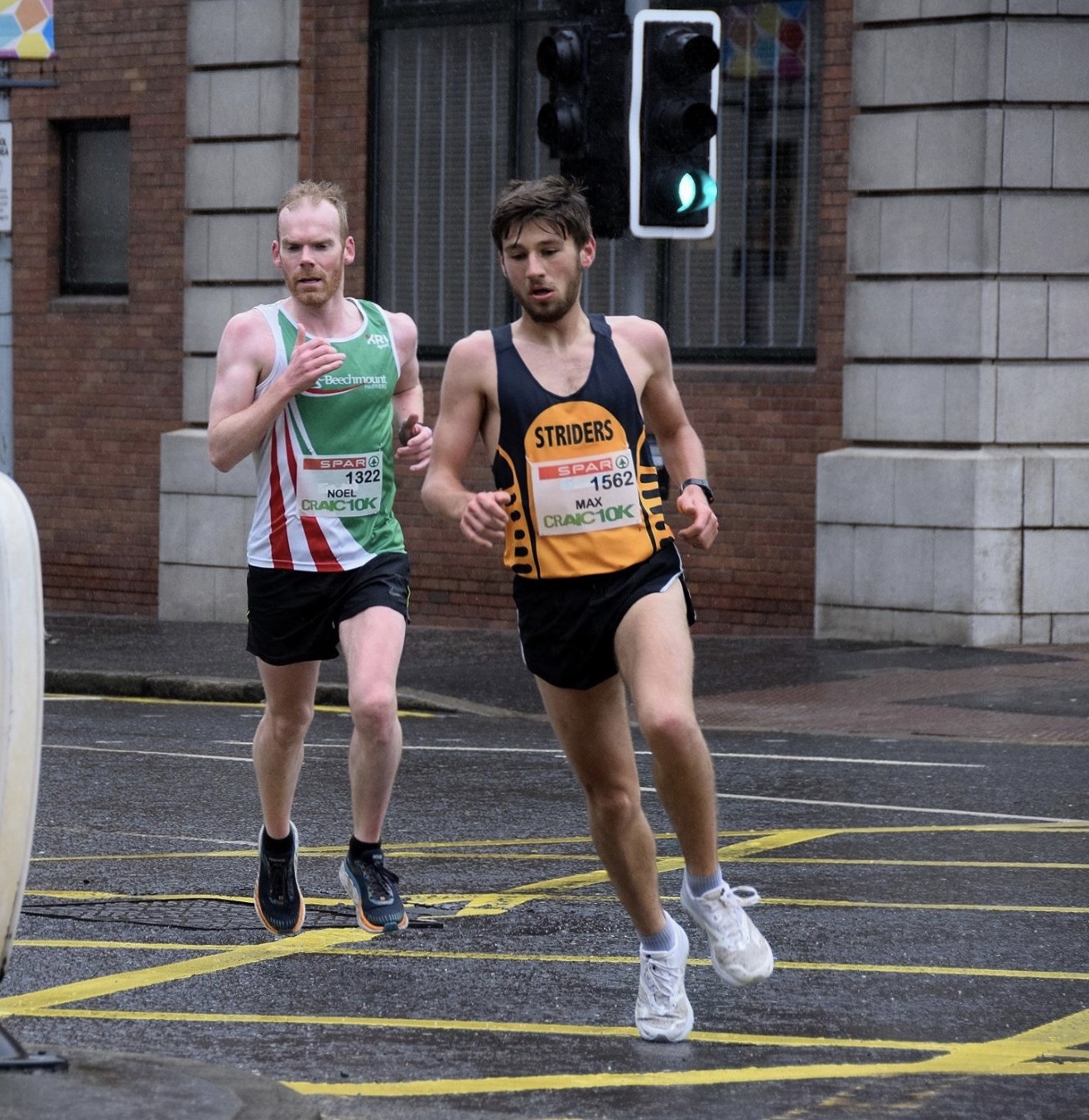
Shortly after passing Falls park the course took a sharp left turn and there was a steep downhill section that I was able to make use of to close a c.40m gap on one of the runners ahead of me, and gave me a little momentum going into the second half of the race. At this point (roughly 4km into the race) I began to realise I now only had one other runner for company – a Beechmount Harrier. We traded the lead as we ran up the Dublin Road and through the Botanic area of Belfast, still facing driving wind and cold rain, and just as we exited Botanic park and came onto the banks of the Lagan river he managed to gain a little separation, which he would gradually eek out to a 7-second advantage by the end of the race. The final 3km of the course was entirely within Ormeau park, and even though the flood water had been drained away, the twists and turns as well as the slight undulations of the park roads made making up ground quite difficult. Regardless, I felt surprisingly good for the final third of a 10km race, and I was able to finish fairly strongly in 6th place with a time of 33.38 – only 9 seconds outside my PB on a far less favourable day. The main thing I noticed at the finish line was how cold I was, though. Having spent the last half an hour running through cold rain in a thin vest and split shorts I felt like curling up in a ball and calling it a day. There was no option for that, however, as Devlin was soon powering through the finish line and we were on our way home, trotting along at a pathetically slow pace and trying to ignore our rapidly-deteriorating speech and fine motor abilities. Once we were back in the flat we had to chance to reflect on our performances, and decided they were good enough to continue with St Patrick’s Day in the originally-intended style.

Finished – at last

Paddy’s Day

Post-race I can’t say I was fully satisfied, but the race was a solid enough effort that I could forget about running for the rest of the day and head out into Belfast for the day. Remarkably, the storm we had run through just a few hours previously had disappeared, so it was possible to walk around Belfast without risking hypothermia – which had seemed like a distinct possibility when I was sitting in Devlin’s flat wearing four layers an hour after the race. I will put that inability to deal with the cold down to training for the marathon – I received a few comments about how lean/skinny (depending on who you asked) I had become. After drinks in a few different Belfast houses and another trip to Lavery’s, the time to head back to Dublin airport arrived – a genuinely depressing realisation at 11.45 pm when I felt like I was just getting started with my return to Belfast! I caught the bus and, predictably, fell asleep almost immediately, waking up well past Dublin airport and having to flag down a taxi at two in the morning. The departures area of Dublin airport doesn’t even open until 4am so it was a long wait until I could finally find some food – I had barely eaten all day – and then my flight was delayed by an hour, so when I finally got back to Madrid I was fairly fed-up, in addition to being exhausted and hungover. The trip back to Segovia was pretty much pain-free, though, and included a quick chat with coach Sonia to sort out this week’s training, which includes a ridiculously hilly half marathon race on Sunday in Segovia. You’ll hear all about that next week. A luego.

Weeks 8, 9, Food for thought

Week 8 (25/2 – 3/3)

  • M – 1,500m swim (29′) + 20′ prehab
  • Tu – 78′ easy (16.1km) + 1,500m swim (29′)
  • W – 84′ fartlek – 12×3’/1′ + 4×30″/30″ (20.1km) + 20′ gym
  • Th – 77′ easy (16.1km) + 1,000m swim (22′)
  • F – 1h39′ track session – 3x(3200/90s, 4×400/45s) (25.5km)
  • Sa – 74′ easy (14.4km) + 1,500m swim (31′)
  • Su – 2h36′ steady (37.4km) = 129 km

Week 8 started slow, and finished fast. The Tuesday run and Wednesday fartlek runs would best be described as slogs. On Thursday I was absolutely exhausted (I’m surprised I didn’t sink during my swim, honestly), and I was dreading my Friday track session as it loomed at the end of the week. Throughout the warm up I kept my mind occupied by other things, humming quietly to myself as I made my way to the track, and then once I arrived I told myself I would take the session one rep at a time and not look at my watch too much. I had worked out that the session would be 36 laps of the track, 14.4km or 9 miles of fast running. I didn’t want to set off too fast. The first set passed without incident – 11.19 for the 3200m rep, 77 or 78 seconds for the 400m reps. The 400s were quite depressing, as the last time I ran a 400m rep before this session was in July 2017, when I finished a session with a 58-second lap – a full 20s, or 130m, superior to what I was lapping in. A 3-minute jog between sets allowed me to recollect my thoughts, and my second 3200m was a lot quicker – 11.05, followed by some slightly faster 400s than the first set. The second 3-minute jog was a dreary affair, I was definitely hurting. The last 8-lapper was miserable, I felt slow, I was struggling mightily, and the laps seemed to be getting longer. So when I finished with my fastest split of the session (11.02) I felt a bit of a boost, and I was able to quickly dispatch my last set of 400m reps and finish the session at long last! One slightly amusing feature of the session, which took around an hour to complete, was the changing demographic of the track as it wore on. At the start of the session I had two old men for company, who were redrawing the lines on the football pitch on the infield. Sometime before my first recovery jog two more men arrived, running in the outside lane in the opposite direction to myself. The old line-drawers left towards the end of my second set of reps, and the pair of runners finished their run around the same time. The two runners then spent around 10 minutes stretching, glancing over at me as I finished my second set and started on my third, and then headed to the stands to get changed, still watching me struggle around the track. They then stood, still watching, as I tore through my final set of 400m reps, and left when I still had two reps to complete, clearly under the impression that my session wasn’t going to end for a while yet. I was thankful for the audience, while it lasted, and chuckled internally as they disappeared. The week ended with a long run. A long long run, at that. However, I had learnt my lesson from the previous week, and invested in a new gel (this time from Decathlon) and brought a small bottle of water to wash it down. I was running relatively early in the day (I started a little after 9 am) but the sun was shining and I was grateful to have some water as I tackled the dusty farm trails around Segovia. I took the gel at 24km and for the first time since the New Year I actually felt half decent in the final 10km of my long run, finishing the 37.4km in 2 hours and 36 mins – an average pace of 4.11/km (2.57 marathon tempo). At 129 km I have only run more kilometres in a week once before – two weeks prior to this.

Week 9 (4/3 – 10/3)

  • M – 1,000m swim (21′) + 20′ prehab
  • Tu – 79′ easy (16.1km) + 1,500m swim (29′)
  • W – 1h40′ session – 50′ tempo (23.5km) + 20′ prehab
  • Th – 75′ easy (16.1km) + 1,500m swim (30′)
  • F – 77′ track session – 10×800/90s (19.0km) + 20′ prehab
  • Sa – 77′ easy road run (15.5km) + 1,000m swim (20′)
  • Su – 1h50′ steady, including 12×1’/1′ (26.8km) = 117 km

Understandably, when I woke up on Monday morning I wasn’t in the mood to test my endurance, so a 1,000m easy swim sufficed for the day’s aerobic training. Tuesday was very average, deliberately so. Wednesday was due to be my first long tempo effort of the training block, and I didn’t want to start it with knackered legs. Unfortunately, the weather didn’t want to play ball. I started the run under a huge black cloud, which I hadn’t been expecting at all – the weather the last few weeks in Segovia has been heavenly. The rain I was anticipating never came, but in its place came something far more frustrating – strong winds. The route I was using was out-and-back, starting with a long gradual downhill section and finishing with the long drag uphill. With a strong wind at my back and negative gradient beneath my feet I was floating along, but I knew exactly what lay ahead, so there was little enjoyment to be had in the relatively effortless first half. Coming back up the hill, things appeared to be ok. The wind seemed to be blowing over the top of the hill I was summiting and not into my face. Until I summited. Then I felt like I was running on the spot, my feet occasionally knocking into one another as strong gusts hit me head-on. I finished the 50′ tempo section well down on where I thought it would leave me on the course, meaning my cool down was a lot longer than planned, and I got home fairly frustrated. After some rational thought and a text from coach Sonia I realised it wasn’t such a bad session considering the strong winds and the seven days of training that was in my legs already. I’m sure I’ll get the chance to do a longer tempo effort in better conditions in the coming weeks. Friday’s session was done in similarly freaky conditions – this time I was being pelted with freezing rain. Regardless I was able to run a solid session of 800m reps, which felt remarkably short compared to the previous week. Finally, Sunday brought the traditional long run, though it also marked a break from tradition. For the first time in 2019, I had a Sunday run which wasn’t either 1) longer than 2 hrs; or 2) a race. A welcome change indeed. I never thought 20-lap track sessions or 26-kilometre long runs would feel short, but I suppose that’s what marathon training does. If/when I go back to 1500m training hopefully I’ll be able to remember what a 36-lap track session feels like and not complain so much about a 10 – 12 lap session.

Food for thought

*Blogs. Meme courtesy of Harry Travers (2017)

Let’s start with a CLASSIC joke:

Q – How do you know if someone is vegan?

A – Don’t worry, they’ll tell you.

Consider yourself told, 8 blog posts in. I’ve been vegan for a few years now (since Ash Wednesday, 2016) though there have been a few slip-ups, usually in Africa, strangely enough. Don’t worry though, dear reader, I’m not going to try to convert you, please read on. Now something that one of my best friends likes to say with unbelievable frequency is “just because it’s vegan doesn’t mean it’s healthy” and he is quite right, though in my personal opinion people would be a lot healthier if they stuck to plant foods. Recently I taught a lesson to my adult evening class and our topic was food. We all had to tell the class what we eat on a daily basis and when I wrote my own diet on the board as an example it dawned on me that surviving on black coffee, bread, hummus, heaps of pasta and rice probably isn’t the healthiest form of sustenance available to me. And if you think that sounds like a bland and possibly unhealthy diet, you should see what happens when I travel. Airports and bus stations don’t tend to have an organic buddha bowl waiting for the weary traveller, so when I travel for races I often end up eating a share packet of crisps for dinner, or at best a bag of mixed nuts. The night before the Murcia Half Marathon I remember walking around the town trying to find something healthy and plant-based to eat, and ending up with a large bag of Walkers’ ready salted in my hands. Or before the Aranjuez 10K in December, I visited Taco Bell on Madrid’s Gran Via. I’m a big believer that the most important thing is to eat something, particularly as the race distance increases and the amount of fuel in your muscles becomes a deciding factor in race performance, but with a marathon I think it will be important to eat the RIGHT thing. Similarly, I have been experimenting with gels on long runs, as it would be a real shame to put together a strong training build-up (as this one has been, so far) and then have a nutrition-related disaster on race day.

So as of Ash Wednesday, 2019, I have been trying to work out a slightly better diet. So far that has meant giving up hummus for lunch in favour of a sweet potato and salad, and trying to organise my shopping trips so I have ripe bananas for breakfast (so far this has been a spectacular failure and I’m stuck with “tostadas con mermelada por todos los desayunos” – apologies to anyone who actually speaks Spanish and can see any glaring errors, the Mormon elders who are teaching my housemates and I Spanish weren’t around last Friday). I had a phone call with an ex-teammate from Wells City Harriers, from whom I gleaned some useful ideas, and hopefully with some personal experimentation I’ll get the food side of the marathon right. This coming weekend I will be in Belfast for St Patrick’s Day to race the Craic 10K and practice my pre-race nutrition and post-race celebration, as well as hopefully improve on my 33.29 10K PB from December.

Until then, ciao….

Weeks 6, 7 (T minus 10 weeks)

Week 6 (11/2 – 17/2)

  • M – 1500m swim (29′) + prehab
  • Tu – 78′ easy (16.3km) + 1500m swim (28′)
  • W – 1h36′ session – 3×18′ @ MP (23.6km) + prehab
  • Th – 75′ easy (16.1km) + 1500m swim (28′)
  • F – 1h35′ session – 3x(1K/2K/1K) (22.4km) + prehab
  • Sa – 70′ easy (14.5km)
  • Su – 2h42′ steady (37.5 km) = 130 km

The biggest training week of my life, including two confidence-inspiring sessions, and my longest-ever run. The Wednesday session was a bit of grind and quite unlike anything I have done in training before. When I was training for 1500m and 3000m events on the track I could tell you with confidence what my least favourite session was: 20 minute tempo run. So when I saw 3×3 miles on my plan I thought to myself “Christ, 3x a session I hate”. In the end it wasn’t all that bad. I adapted the session to 18 minute reps and had an easy 3 minute jog between each, and averaged right around 3.43/km (or 6 mins/mile) for the three reps, completed on a rolling hilly course. Friday was a big session, but once I got started I found I was able to just click off the laps, and gradually increase my pace as the session wore on. I started just inside 3.30/km and finished with a 3.19 kilometre to average 3.25/km for the entire session. Both the Wednesday and Friday sessions had an interesting feature, they were what I will call “marathon pace in disguise”. Strava has a feature which shows you impressive stats (relative to your previous running) post-session. The 3×18′ session, including two 3-minute recovery jogs, came out to a 61.04 10-mile clocking (2:40:04 marathon pace). The Friday session, including the 90s jogs between reps and 3-minute jogs between sets, came out to a 60.24 10-mile (2:37:59 marathon pace). I haven’t got a concrete marathon goal time in mind at the moment (not one I’m willing to share, anyway), but hopefully a few more sessions like these will give me a clear idea of what I’m capable of on marathon day. A night out and half a day of walking in Madrid with a friend from Belfast ensured my Saturday run was a hungover slog, and the week finished with a *very* long run, which ended with me lying exhausted on a bench outside my house, a fairly unusual sight at any time of day but especially at noon on a Sunday as a nearby church emptied and the congregants walked past. “Lo siento, estoy muy cansado!”

Week 7 (18/2 – 24/2)

  • M – 1000m swim (20′) + prehab
  • Tu – 78′ easy (16.1km) + 1500m swim (28′)
  • W – 1h39′ session – 2×25′ @ MP (23.6 km) + prehab
  • Th – 75′ easy (16.1 km) + 1500m swim (28′)
  • F – 79′ session – 4x(1200/1200) (18.9 km) + prehab
  • Sa – 75′ easy (16.1 km) + 1000m swim (18′)
  • Su – 2h19′ including 12×60″/60″ (32.4 km) = 123 km

With a heavy week in my legs I was fairly sure I was due some underwhelming sessions in week 7. In the end, I had to wait until Sunday to feel the pain of accumulated fatigue, not helped by staying out until quarter past six in the morning – blame Spain for that one, in an ideal world I would have a night out start at 8pm and finish at midnight! Wednesday’s session was a tough one mentally more than anything else. 25 minutes is quite a long time to be running hard, so doing it twice with a short 4-minute jog to break up the painful monotony wasn’t exactly enjoyable. The overall pace was slower than week 6’s tempo efforts, but not much slower (6.06/mile, or 3.48/km). Friday was the definite highlight of the week. I never thought I would say this but a 24-lap session on the track felt like it was over as soon as it began. I went into the session with the goal of running around 4.10 for the first 1200m rep, taking a 90s recovery jog and then going for something close to 4.00 for the second rep. The times slowly tumbled over the course of the session and I ended up averaging 4.02 for the 1200m reps (all eight of them!) and running my last three-lapper in 3 minutes 50 seconds – eleven seconds faster than my next best in the session! Friday also brought my first Spanish class in years, during which my housemates and I tried to wrap our brains around the difference between “ser” and “estar”. More challenging than the morning’s track session, in honesty. Finally, the week ended with my first ‘quality’ long run. The run started innocuously enough – 90 mins at a solid pace – but became a struggle shortly thereafter. After 1 hr and 28 mins of steady running I was to eat (drink?) an energy gel, which turned out to taste absolutely terrible and have the consistency of the free lube handed out at freshers week. With that down my gullet, I had to embark on a series of 1-minute repetitions, 12×1 minute fast, 1 minute slow. Through a combination of being hungover, running in the early afternoon because I had slept in, and trying to hold down the putrid gel, the next 23 minutes of my life were intensely uncomfortable! I eventually got through the reps, jogged back to the house and recreated my earliest memory of marathon training: looking out the kitchen window at the age of 9 to see my dad sprawled on the lawn post-20+ mile long run (also carrying a hangover at the time, I remember). Hope he doesn’t mind me telling that story. It only happened once…

T-minus 10 weeks

*have run

The realisation that in 10 weeks’ time I will have run a marathon (hopefully in a good time) is a bit daunting. But it also allows me the opportunity to reflect on what I’ve managed so far. Prepare yourself for numbers from the mathematical equivalent of a dyslexic. 7 weeks of training completed. 805 km (or 500 miles) in total, which means I have averaged 115 km (or 71 miles) per week since I started training in earnest back in early January. 5 runs of 20 miles (32 km) or longer. My longest ever run in terms of both duration and distance (37.5 km/23 miles). A 30-lap track session (before marathon training the biggest session I had ever run on the track was a paltry 20 laps). A 3rd place finish in my first half marathon.

Enough back-patting and sketchy sums for now, as there are some lingering doubts. The main one is trying to work out how a pace which is challenging to hold for much longer than half an hour in training is going to be my race pace for more than 2 1/2 hrs. Luckily I have a coach now so I don’t need to work this out on my own, which is a great relief with ten weeks to go and no marathon experience. I’m fairly sure I would either dig myself a giant hole to fall into (injury or fatigue, or both, lying at the bottom) or leave a few too many boxes unchecked and arrive at the start line on 5th May missing some vital marathon-training ingredient, were I left to my own devices.

Going forward, I have two more full weeks of training before my next race – the Craic 10K in Belfast on St Patrick’s Day, the week of which will serve as a bit of a break from training. Depending on how the next two weeks go, I am hoping to shatter my 33.29 PB from December. Until then, head down.

Week 4, 5, a Monumental run, and something else

Semana Cuatro

  • M 28/1 – 1,000m swim (19′) + prehab
  • Tu 29/1 – 71′ easy run (14.4 km) + 1500m swim (29′)
  • W 30/1 – 1h 33′ fartlek – 4×8’/2′ (21.5 km) + prehab
  • Th 31/1 – 72′ easy (14.4 km) + 1500m swim (29′)
  • F 1/2 – w/u, 10x1K/90s jog, c/d (19.5 km) + prehab
  • Sa 2/2 – 74′ easy (15.0 km) + 1500m swim (29′)
  • Su 3/2 – 2h 17′ long run (32.4 km)
  • = 117 km (8h 49′) + 5,500m swimming

Coming off such a pleasing run at the Murcia half marathon, week 4 was a reality check and a bit of a grind. Coming down after a really good race can be a bit of a challenge – it was for me anyway. 21 kilometres of racing followed by a 500km journey back to Segovia meant that it wasn’t until Thursday that my legs felt relatively normal again, and then I went and ran ten 1,000m repetitions on the track to put my legs straight back in the state they had been in all week. All three sessions were mightily average – Wednesday’s fartlek saw me struggle to hold my anticipated marathon race pace for four measly eight-minute reps. Friday was a tough one also – despite the rep times being quite modest: 3.26 average, with a steady progression from an opening 3.36 km to a 3.19 final rep. Sunday was the first time I have tried to inject a bit of quality into a long run so far, and I found that running fast with 20km in your legs is actually quite difficult. Bodes well! Regardless, a good week in terms of volume. In other news, almost every run was carried out in single-digit or sub zero temperatures and Friday’s run was conducted in a light snowstorm.

Semana Cinco

  • M 4/2 – 2,500m swim (49′) + prehab
  • Tu 5/2 – 70′ easy (14.4 km) + 1500m swim (30′)
  • W 6/2 – 1h 41′ fartlek – 4x(4,3,2’/1′) (23.5 km) + prehab
  • Th 7/2 – 69′ easy (14.8 km) + 1500m swim (29′)
  • F 8/2 – 16K progression + 4×30″/30″ (20.1 k) + prehab
  • Sa 9/2 – 68′ easy (14.4 km) + 1500m swim (29′)
  • Su 10/2 – 64′ easy, Monumental 10K, 17′ c/d (26.3 km)
  • = 113 km (8h 28′) + 7,000m swimming

With week four out of the way, I was able to go into the fifth week of my training with a bit more enthusiasm, knowing I had a slightly more exciting plan for Sunday than a steady 32 km long run. Wednesday was a real donkey-work type of session, especially as I misread AND altered my prescribed session (yes, you read that correctly. I have a coach now, more on that later…). What was supposed to be 4 or 5 sets of 3′, 2′, 1′ with a 90s jog recovery became 4′, 3′, 2′ with a minute recovery. Unsurprisingly, I had a hard time maintaining any kind of pace on the 4th set but did eventually finish the workout and get home with another 23 km banked. The Friday progression run was tricky as I chose an out-and-back course which slopes upward as I approach home, making a big increase in pace difficult. The effort was there, if not the pace, and that left me with just one big effort to go before I could call it a week…

VIII Carrera Monumental Segovia “10K”

The race started under the Roman aqueduct

“Training through” a race is a very unusual experience. I have done it a few times, rarely with any great success but it can be a fun way to break up training. In the five days before the race I clocked up 87 km of running and 7km of swimming, so I wasn’t exactly feeling fresh or rested on Saturday night as I tried to work out the course map. Having not eased up for the race I felt almost no nerves the night before – I was fully expecting to have a poor run! I set my alarm and as this is marathon training, headed out the door an hour and half before the race to do a fairly standard training run pre-race – 13.9 km in 64 mins. On arrival at the start line I still had about 20 minute to kill before we were to set off, so I set about finding “la guardarropa” – which according to Google translates to wardrobe but in the context of a race setting in Spain is the place where you leave your valuables and warm-up kit before you head to the start line. As it turned out, this race didn’t have one (“donde es la guardarropa?” – “no hay” – “hoder”). Fortunately, my house is about 500 metres from the start line of the race so I was able to leg it home, change into my race kit (including finding some shorts which would accommodate my house keys – purple half-tights to the rescue!), and leg it back to the start line. I made it back with a few minutes to spare, and before I knew it I was careering down a 2km hill in a pack of about 15 guys at the front of the race.

1km passed in 3.03, and the second kilometre was a similarly swift 3.07. Then we turned a corner and were faced with an enormous hill, which reduced my pace to 3.47/km. I spent the rest of the race battling up hills, swerving around sharp corners and bombing down steep cobbled hills, maintaining that 3.45ish/km rhythm. Usually I would be very disappointed with that pace for a 10km race, but under the circumstances I was just happy to be holding my position in the race. Around the 8km point I began to hear the slapping of feet on the road behind me and some heavy breathing, but thankfully I never saw the owner of them as I sped up sufficiently to get away. The one piece of proper preparation I did for this race was map the final 3km of the race backwards so I would know when I could start my big push for home, and I nearly closed the gap on the guy ahead of me in the long final straight, though I ultimately ran out of road. I was very surprised to see a finishing time of 33.17 (a 12-second improvement on my PB) as I crossed the line, but a quick glance at my watch showed me the course was about 600 metres short. I finished 10th overall, the winning time was a swift 31.40.

A brief cool down later I was back in the house, coffee in hand and feet up – 26 km banked for the day and 113 km for the week.

Kilometro uno. Where’s Wally?
Above: how not to run a 10K

Something else

A dedicated reader of this blog might remember that two weeks ago I mentioned meeting Sonia Samuels and her husband Nick after the race in Murcia (both of whom ran half marathon PBs this weekend in Barcelona, incidentally – 67:18 for Nick, 72:19 for Sonia). I remember being asked by Sonia if I had a coach, but in my post-race delirium I must have dismissed the question or moved onto a new topic far too quickly, because one week later I came back from my long run to find a message on my phone from Sonia, offering her coaching services! At first I was reluctant to have a coach again, but a few messages and a brief chat over the phone settled any worries I had. It is an exciting and rare opportunity to have an Olympian in your corner, and I feel extremely lucky to have stumbled into the Samuelses post-race. I will take credit for my running from September 2018 to the end of January 2019, but as the 5th May approaches I am now happy to hand over the reins to someone who knows how to run a fast marathon and share any future success. So going forward, know that an Olympian suggested the sessions I will be writing about! Until next time…

Week 2, Week 3, Race 1

Week 2:

  • M 14/1 – 2,500m swim (50′) + prehab
  • Tu 15/1 – 68′ easy run (14.4 km) + 1,500m swim (29′)
  • W 16/1 – 1h 39′ fartlek – 5×5’/1′ (23.3 km) + prehab
  • Th 17/1 – 72′ easy (14.4 km) + 1,500m swim (30′)
  • F 18/1 – 10×800 – 2.43 average (90s recovery) (18.0 km) + prehab
  • Sa 19/1 – 63′ easy on roads (13.6 km) + 1,500m swim (30′)
  • Su 20/1 – 2h 23′ steady long run (32.4 km) = 116 km

The second week of training was a bit of a shock to the system, if I’m perfectly honest. The biggest lesson learnt was a simple one – if you’re planning to run for a long duration, pace yourself! Wednesday’s fartlek was a real soul-crusher, as after a very fast few kilometres I completely fell to pieces, forcing me to jog the remaining 10 or so kilometres back home. Painful. Friday’s session was less brutal. Apart from one very brief 2km pace run in November, Friday 18 January 2019 marked the first time I had stepped onto a track for a session in 16 months (since my last track race, late July 2017!) As might be expected, I was a bit rusty and the early splits were slow. I tried to focus on the task at hand and just get through the 10 reps, and after I had run five repetitions my legs came back to me and I was able to run low 2.40s for the last few. I suppose one of the biggest benefits of marathon training for me is the fact that the track sessions I do are simply for a bit of turnover. It doesn’t particularly matter if I run 3.20 or 3.30/km pace, so long as it is substantially faster than my expected marathon pace (which both 3.20 and 3.30 are!) The week ended with a fairly standard feature of any marathon plan – the steady 30+ km run. I was feeling fairly rough that day and it took an unusual effort to get my trainers on and get out the door. Regardless, I got the run done (through grunts and expletives) and wrapped the week up with a total of 116 km of running. In addition to my running kilometres, I also racked up 7,000m in the pool, including a very satisfying 2,500m in 50 minutes – eleven minutes faster than the first time I tried 100 lengths of the pool!

Week 3:

  • M 21/1 – 2,000m swim (39′) + prehab
  • Tu 22/1 – 70′ easy run (14.4 km) + 1,500m swim (27′)
  • W 23/1 – 1h 32′ fartlek – 10×3’/1′ (21.6 km) + prehab
  • Th 24/1 – 76′ easy (14.4 km)
  • F 25/1 – 72′ light progression + 4×20″/40″ (16.4 km)
  • Sa 26/1 – 30′ easy (5.6 km)
  • Su 27/1 – Media Maraton Murcia (28.2 km with w/u & c/d) = 100 km

Week three marked my first competition of this marathon buildup, and that meant a fairly noticeable reduction in training from Thursday on. Monday’s swim was solid, though I feel I still have a lot to learn on the front of pool-etiquette, particularly when I am sharing a lane with people travelling a little more slowly than I am. Tuesday’s swim was fantastic. The first time I attempted 1500m in a reliably-measured pool it took me 32 minutes to travel the 60 lengths up and down. On Tuesday took over a minute off my best time so far to swim 27 minutes 35 seconds. I then looked at the British swimming rankings to see how I stack up and it turns out you’re not even close to good until you are swimming well under 20 minutes. I guess I’ll stick to running. The Wednesday fartlek was a very relaxed affair. I knew I was heading into uncharted territory with the half marathon on Sunday, and didn’t particularly want to line up with heavy legs, so I opted for a relaxed session of ten times 3 minutes fast, 1 minute slow. I ticked the box, and from there I spent the rest of the week simply trying to feel fit and take it easy.

Race 1 – call it a debut

When I read the press release for the upcoming London Marathon, I was slightly irked by the fact that both Brett Robinson (Australia) and Ibrahim Jeilan (Ethiopia) were listed as “debut”. Robinson started a marathon last year in Japan but failed to finish, dropping out around the 35 km mark, and I distinctly remember Jeilan running the 2014 London Marathon alongside Mo Farah (which given their competitive history must have given Farah something to think about), which he also dropped out of.

You might be wondering why I am grumbling about running semantics, but I promise it is relevant. When I told friends that I was running a half marathon, the word “debut” was similarly bandied about. But back in 2015, during my first year of university, I actually did start a half marathon. And it was an utter disaster, coming off a period of very spotty training and zero long runs. I passed 12 km on pace for a sub eighty-minute clocking, but soon felt something odd in my calf and had stepped off the course by 13 km (much to my brother’s surprise, who saw me limping through the crowds as he pushed on to a 1.31 clocking – improved to 1.25 the following year). So I have a DNF on my record, and reservations about calling Murcia my debut.

For the sake of simplicity, though, I will assume the London Marathon organisers’ understanding of the term is more accurate than my own, and call this a debut. I chose Murcia as it has a flat course, is at sea level, and provided a great opportunity to lay down a marker early in my training. Getting to Murcia was a bit of a faff. I had to get a bus down to Madrid, travel across Madrid to get to Estacion Sur, and then endure a 5hr bus journey from Madrid to Murcia. On arrival in Murcia, I then had to locate my hotel, possessing zero local knowledge and a phone on 7% battery. I made it, charged my phone for a brief few minutes and then had to hunt down the race pack collection point. I terrified a few Murcianos with my awful Spanish but eventually I was guided in the direction of the sports centre, and collected my race number and the bounty of goodies – two T-shirts, arm sleeves which I will never use, vouchers and coupons.

A typical bit of advice given before races is to conserve energy, mental as much as physical. But all the messing about to 1) get to Murcia; 2) find my hotel; 3) find the race pack collection point; and 4) get back to my hotel left me feeling very spent come 10 pm Saturday night. Which was excellent, because that meant I got the most sleep I’ve ever enjoyed the night before a race – 6 hours! That might not sound like a lot, but compared with the usual 2 – 4 hrs I get before races (on account of nerves) it was a revelation. I woke up at 6am, before my alarm, and was able to get some breakfast (kindly put on a few hours early by the hotel staff) and a shower before heading out for a warm up. It was chilly at 8.30 when I started jogging, but I felt fantastic at the end of my warm up jog, and the conditions were just about perfect – no wind, clear skies, cool temperature. I finished off my warm up with a few sharp strides down a side-alley and then headed to the start line. I tried to slide into the first pen of athletes, the guys wearing split shorts, racing flats and club vests. But I found a race official in my way, pointing at the number on my bib and repeatedly exclaiming “tres”. After a brief moment of pleading “por favorrrrr” with my hands clasped together in prayer, I realised I would just have to suck it up and head to the third pen. For a bit of reference, which was no help to me whatsoever, there were marathon pacers with big flags on their backs. I was behind the 4hr pacer for the marathon, and a few hundred more bodies. As the crowd condensed I was able to slide forward a little, but when the gun went off I had at least two hundred people in front of me.

My first thoughts probably can’t be repeated in writing without coming across very poorly. So I swore to myself internally as I jogged along with the crowd through the start line, and wove up the Gran Via. After about 400 metres we turned off Gran Via onto a road following the river. With open road ahead, I took off, and after an opening kilometre of 4.00 I was able to settle into a routine of high 3.20 and low 3.30 kilometres for the rest of the race. In a way, I think starting further back helped me, as I was able to methodically pick my way through the field for the first 7km. On the other hand, it was quite stressful knowing I was about 25 seconds down on my goal pace less than 5% into the race. It was quite a unique experience, gradually running through every pace bracket from the 2 hr half marathoner all the way to the sub 1.20 men and women I finally caught at 7k.

By 8km I was all alone except for a cyclist with a big balloon on the back of her bike. When I asked what position I was in, she let me know I was in third (*fist pump*) and that it was her job to follow me until the finish or someone else moved into 3rd, whichever came first. Finding out I was in third was a huge boost, and I was able to dial back the effort a little and just maintain a good rhythm through the next ten kilometres. As the race progressed I had noticed that my garmin watch was beeping about 150 metres before the road marker for each kilometre, so I kept myself busy doing mental maths to work out what pace I was on, and around 16k I realised I was well inside my pre-race goal of maintaining 3.36/km. At 17 or 18 km I began to feel very rough, as the sun rose higher and I passed the hour mark. I checked my watch the 20km marker on the road and saw 1:11:06 – which is exactly 75.00 pace, and continued to drive onwards, grateful for the crowd support – “vamos!” “animo!” “venga venga!”. I didn’t check my watch at the 21 km mark on the road as I knew I would only have about 100 metres of running to do, but then I noticed that there was a fair bit of road to run down before even turning into the finishing straight, a fairly dispiriting sight! I kept pushing regardless, and finished with 76.03 in third place – a very satisfying debut!

In honesty, I think the drama at the start probably helped me. I have a tendency to start too fast in road races and even running 13 km alone felt like a very long way. Had I been at the front with the guys pictured above, I either would have tried to follow them and died a horrible, painful death, or I would have been in no-man’s land from the very start to the finish. At the end of the race I noticed that both the winner and the 2nd place finisher were speaking fluent English with no Spanish accents, and realised that this was an international podium – two Brits and a Belgian. The other Brit – the winner – looked awfully familiar, and I was sure I recognised the woman holding his belongings at the finish line, too. We slowly walked through the finish area about to start our cool down and sharing names, when I realised I had watched both of them race on TV! The woman holding the bags was none other than British Olympian and 2.28 marathon runner Sonia Samuels, and the winner of the race was her husband, Nick Samuels, the two of them based in Murcia for a 5-week training camp to avoid the depressingly cold English winter. They were both charming and polite, and very reserved about their own running which was disarming. I’m not sure if Nick was amused or worried when I recounted the race I had watched him pace back in 2013 (the Glasgow Half Marathon edition of the Great Run series), but being the running savant I am I couldn’t resist sharing. After cooling down we waited for a while for the trophies and photographs on the podium, but with a 12 noon hotel check-out time looming and the awards ceremony running on Spanish time, I made a hasty getaway at 11.30. A quick shower, then I was off to the bus station (via a bar for a pair of Estrellas and some tapas) to commence the journey back home, which was predictably uncomfortable given the state of my calves and hamstrings post-race.

All in all, an intensely satisfying start to this marathon training cycle, and hopefully with fewer mishaps I’ll be able to shave a bit of time off that new PB. For now, back to training…